On Thursday, we celebrated International Women's Day here in Mwandi and throughout Zambia. It is a day when the world comes together to celebrate the achievements of women.
The Socialist Party of America in 1909 –(yes, there is such a thing!) instituted the first Women's Day following protests against oppression, unfair pay, working hours and the right to vote. Over the years women and men have gathered around the world to stand in solidarity and campaign for the rights of women.
Women still do not receive equal pay. They are underrepresented in the global business and political spheres. Even within the Church women are not offered an equal platform. In many places women are still denied the opportunity to further their education. Violence against women is commonplace and far too often ignored. Though changes and developments have taken place over the past 100 years, more still needs to be done.
The theme this year is 'Empower women - End hunger and poverty.' Time was spent remembering the many women around the world who have made a difference and continue to do so, the mothers, daughters and wives whose works have challenged and changed the world.
Yesterday the Zambian Government announced that for the first time the Gender Department would become a full-scale Ministry with a Cabinet seat. This follows in the wake of a number of women being promoted as Heads in various areas of the Public Service. The Police Inspector General, some Provincial Police Chiefs and Director of the Anti-Corruption Commission are the most prominent recent appointees.
Mothering Sunday was celebrated last Sunday on 4 March 2012. The UCZ theme was The Transformed Woman Impacts Community based on Romans 12:2, Matthew 27:55-6 and Acts 16:14-16. Ida was asked to preach at Mwandi this year. She stressed that the need for female education goes hand in hand with spiritual transformation. For the transformed woman the community is an extension of her family and home. Jesus’ ministry was supported by transformed women, individuals in their own right.
The love and care for orphans is part of the role as is standing against child labour and trafficking. Defilement, early marriages abuse and violence are unacceptable to the transformed woman. She supports victims of gender-based violence (GBV) and their struggle for justice.
Lydia was a good example of a woman opening her house to help and support Mission Work. Aquila and Priscilla’s was a joint-ministry, important in a Christian marriage, working together to share the Gospel. The Transformed Woman impacts her community by allowing God to use her strengths and gifts to extend the Kingdom.
Finally on Friday afternoon last week the World Day of Prayer Service took place at Mwandi. This event grew out of the 400 women who attended the Edinburgh World Mission Conference in 1910. The Day of Prayer is now a worldwide and ecumenical movement celebrated in over 100 countries.
Participants are encouraged to:
Pray for the whole world and its interdependence
Be enriched by other Christians from different denominations and cultures
Take up others’ burdens and pray with and for them
Become aware of talents and use them in service to others
Prayer and action are inseparable and have an immeasurable influence in the world.
This year’s Order of Service was prepared by the Christian women of Malaysia with ‘Let Justice Prevail’ as their call for prayer. The Readings were from Habakuk 1:2-5, 3:2&17-19 who persistently questions God about injustice and receives an answer that God will act. The New Testament Readings were from Matthew 5:6 & Luke 18:1-8 tell us that God’s justice, righteousness and mercy are inseparable. The Prayer of Confession acknowleged the sin of our indifference to the injustice and unrighteousness we see around us.
Next followed a refection from a brave Malasian social worker who fought for the cause of justice amongst the poor and oppressed concentrating on modern slavery, euphemistically called “trafficking” There followed a challenge on our response to stand up together to help change this situation. (Locally, there are two boys from rural Shangombo at the moment living at Sesheke police station who were rescued as they were about to be trafficked to South Africa.)
2013’s service will be written by the Christian women of France using the text ‘I was a stranger and you welcomed me’.
Prayer points:
We were asked to remember:
Christians in Malaysia who speak out for justice
Victims of human trafficking, oppression and injustice
Wisdom and courage for governments and leaders to act justly
Organisations working for a fairer world – Fair Trade
Migrant workers that they are treated fairly and with respect
The poor, the homeless, the hungry
People affected by HIV/AIDS
Monday, 12 March 2012

Tuesday, 6 March 2012
Living Abundantly
Although Zambia is still 67% covered by forest, concern continues to be expressed at the high rate of deforestation and calls have been made for swift action to address the situation. Since 1990 forest cover has fallen from 52.8m to 49.4m hectares in 2010. There are dwindling timber resources, especially in State and the traditional community managed forests where huge investments are required to replace timber at the rate at which it is being exploited. At present 61% of the forests are community-owned, 24% by the State and 15% by private companies and individuals.
With sensible investment in the local timber industry, a considerable contribution can be made to the development of the Zambian economy. A multi-billion Kwacha furniture factory has been recently opened in Ndola, and the timber industry had great potential to contribute to the country's GDP, if properly and sustainably managed. Illegal timber dealers have contributed greatly to the dwindling of timber resources, and they keep Zambia in the position of a producer of raw materials whose resources have value added outwith the country. Much of the illegally cut timber is hard wood and smuggled out in its raw state. Unfortunately it is only a small greedy elite that benefit at the expense of the communities in which the trees grow. A more stringent monitoring system is needed to stop these illegal activities and keep things in check.
Forestry and all the associated activities, from honey, to nuts, fruits, charcoal and firewood are vital to Zambia's socio-economic development and if managed properly and could create a substantial number of jobs especially for the rural population and this would help to reduce the high poverty levels found there. The UCZ, itself, runs a honey project. It would be ironic if Zambia, country blessed with so much forest cover, in the future, becomes an importer of timber. Malawi’s deforestation and the Caledonian Forest are examples of what can happen over a very short period of time.
The World Bank has just approved a US$50 million credit to improve the productivity of livestock production for targeted female and male smallholder producers in rural Zambia. This is another example of the shift to diversify the economy, from too heavy a reliance on copper mining in industry and maize production in agriculture. It seeks to move a number of successful subsistence farmers to a more semi-commercial status. The project aims to benefit 390,000 female and male smallholder producers in the targeted areas who rear cattle, sheep, goats, pigs and poultry. It is estimated that one million livestock farmers could indirectly benefit from improved control of animal diseases and increased animal numbers. This effort to increase the role of small livestock farming and to diversify agriculture production should help to raise Zambia's GDP, and also raise the standard of living in rural areas and lead to the creation of more permanent and sustainable jobs.
The Mwandi UCZ Agricultural Project and the Mwandi Community Fish Farm were featured last Saturday on the ZNBC Evening News, releasing fingerlings back into the Zambezi to help replenish fish stocks for local subsistence fishermen.
Here the river is rising but the associated flooding in the bush has not reached its usual levels. It has been an average year in our area so far. However, we are being told Southern Africa should brace itself for more heavy rains and floods until the end of this rainy season. Meteorologists warn that tropical cyclones could shake the eastern coast of Southern Africa during March and April.
Despite a late start to our rainy season, much of Southern Africa received heavy rains in late December, which led to some localised flooding. The blame for this placed at the door of La Nina. This is opposite to El Ninõ, which is caused by a warming of waters in the western Pacific which brings drought to southern Africa. Madagascar, Mozambique, South Africa and Angola have all had floods in the past month.
The number of people directly affected by the heavy rain, high winds and flooding caused by two major storms is estimated at 119,000.The gates at Cahora Bassa Dam on the Zambezi are already opened with people living along the lower Zambezi basin and in the Buzi, Save and Pungue basins being sent to higher ground. The Kariba Dam opened its spillway gates of in early January to release pressure on the dam wall. Across the water from us, Namibia has set contingency plans in motion in the Caprivi Region, which is prone to annual floods.
Now finally storms of the political kind: The Mongu Commission, mentioned in earlier postings, recommended this week that the Government should re-instate the 1964 Barotseland Agreement and that it should be part of the new Constitution, but President Sata appears reluctant for the Government to do this.
The Commission also found that the continued denial by the police to allow public meetings violated the rights of assembly and free expression by people in Western Province. Paragraph 7 of the Agreement had also been clearly breached. This concerned the Zambian Government’s financial responsibility to treat Barotseland fairly and equitably in relation to other parts of the Republic. Failure to deal with this had led to high poverty levels and frustrations.
As a result many people were demanding that Western Province should secede from the rest of Zambia because of their growing frustrations at underdevelopment. The committee recommended that dialogue be used in dealing with the agitation to secede, something the previous administration did not do. The Zambian Government should involve the traditional leadership and other key stakeholders to promote national unity. The report would be widely published in the media so that Zambians understood its contents.
Wednesday, 15 February 2012
Two David and Goliath Struggles
Our Aids Relief Programme here at Mwandi has over 1500 people alive today thanks to affordable supplies of ARVs (antiretroviral drugs) from India. The cost of these drugs has fallen from around GBP200 a year to about GBP45 – thanks to the Indian generic drugs industry. This means that international donors, including ironically, the EU’s Global Funding, can help at least six million HIV-positive mostly people in the less-developed world.
Our programme also relies on generic medicines from India to treat other diseases and conditions. But a free trade agreement, currently under negotiation between the EU and India, could greatly restrict the ability of manufacturers in India to continue producing affordable generics that millions of people rely on to stay alive.
At the moment European Union is having trade talks with India and want to increase protection of the intellectual property rights and the commercial interests of European pharmaceuticals giants. They call it "data exclusivity" and along with this the EU is proposing an ambitious enforcement agenda. These harmful intellectual property (IP) provisions will hinder access to quality and affordable generic medicines produced in India, which have played a crucial role in scaling up HIV treatment to more than 6.6 million people across Asia, Africa and Latin America.
The Indian government has raised serious concerns, stating that the agreement could ‘impede legitimate competition and shift the costs of enforcing private commercial rights to governments, consumers and taxpayers’. The European Commission is also apparently pushing for the trade deal to be expanded to cover investments, and not only intellectual property but also an ‘investor-to-state’ mechanism.
This would allow multinational drug companies to bypass Indian courts and take the Indian government to private arbitration courts in investment disputes over intellectual property, which could also lead to the reverse of domestic health policies like tobacco warnings and measures to reduce prices of medicines
The EC are also trying to persuade India to accept restrictions on its generic medicine industry that would mean delays of up to 10 years in producing generic versions of any new, improved medicines and up to 15 years in the case of children’s versions of the same drugs. This is clearly an attack on the health of the world's poor motivated by the callous demands of profit-hungry multinational pharmaceutical companies.
It is vital that this is brought to light and stopped. The rights of people living with HIV having easy and affordable access to essential and life-saving medicine must be protected, especially for the world's most impoverished and vulnerable people.
Greed should not triumph over need.
Yesterday our Chipolopolo Boys, the Copper Bullets, aka Zambia’s National Football Team arrived back home from Libreville, Gabon, to an ecstatic welcome in Lusaka where an estimated 200 000 people thronged the streets all the way from the Airport to the Showgrounds. Winning the African Cup of Nations was something to really celebrate with pride nationwide. People all over the country, including Mwandi, wore football tops, clothes or chitenges in the national colours of green, red, orange and black. Zambia won the African Nations Cup for the first time on Sunday, beating the favourites, the Ivory Coast, 8-7 in a penalty shootout after a goalless draw in the final.
Zambia had been seen as the underdog and had to put up with all the usual patronizing and condescension from the World Soccer Establishment’s pundits at the competition. The Zambian team was considered second-rate, rank outsiders and potential also-rans. So the victory brought some joy and consolation too to this Zam-Scot after our own recent tennis, soccer and rugby disappointments.
The team had earlier paid a moving visit to the beach to commemorate the loss of the 1993 Zambian football team in a plane crash outside Libreville in Gabon where they were to play. That Zambian team was expected to win the game and qualify for the 1994 World Cup but the entire team was wiped out, except for Kalusha Bwalya, now the President of the Zambian FA. So the match on Sunday was a “Date with Destiny”.
The competition comprises of 54 teams and en route to the Championship Final Zambia eliminated Senegal, Equatorial Guinea and Ghana.
The presentation of the cup was a national occasion, to receive it were First Republican President Kenneth Kaunda, Rupiah Banda the former President, the present Vice-President Guy Scott, Kalusha Bwalya and Christopher Katongo, the Captain.
Ivory Coast (Orange): Barry; Gosso, K Toure, Bamba, Tiene; Zokora, Y Toure, Tiote; Gervinho, Drogba, Kalou.
Zambia (Green): Mweene; Nkausu, Sunzu, Himoonde, Musonda; Chansa, Lungu, Sinkala, Kalab; C Katonga, Mayuka, F Katongo.
Friday, 10 February 2012
The cost of a free education
While most of us in the more developed world take universal, free and compulsory primary and secondary education for granted, this is far from being the case in Zambia. This week we heard that the Government has plans to abolish all fees in schools but is hindered by the amount of public money needed to purchase maize through the Food Reserve Agency. After this is achieved, it intends to concentrate spending on education and health to improve peoples’ lives. This will not be possible either, unless, as Kenneth Kaunda pointed out recently, the mining companies raise output and pay their due taxes without equivocation or attempts at avoidance or evasion. Doing this would be a good use of their investment to help grow the economy so that ordinary citizens and their families benefit.
The Government and previous ones were committed to providing free education from Grade 1 to Grade 12, as part of the 2015 Millennium Goals. Goal Number 2 is the provision of universal primary education. To this end the Government has announced the phasing out of the Basic (G1-9) & High School (G10-12) and a return to Primary (G1-7) and Secondary Schools (G8-12). We are still unsure of the timescale for this. Cynics say this makes Goal 2 much easier to achieve. The Government is concerned that learning achievement in the present system is low.
Our High School at Mwandi has been allocated 2 Grade 10 classes this year. Nationwide, 124 333 out of 276 840 pupils will be given Grade 10 places. This is almost 45%. 68 000 boys and 56 000 girls! Not yet gender parity there! 145 000 passed in 6 or more subjects. This is 52%, up from 49% last year. There were 30 000 no shows and 20 000 failed in all subjects.
Related to all this the Jesuit Centre for Theological Reflection has recently published a paper ‘How free is free education?’ www.jctr.org.zm
We have little Ellie staying with us during term time this year. We have known Ellie since she was born. She was born with a club foot and had to have her right knee amputated then. She goes regularly to the Italian Orthopedic Hospital in Lusaka to have her prosthesis adjusted. She started Primary 1 in January this year. Her family lives and farms between Mabumbu and Sankalonga but Ellie cannot walk the 10km to school, hence her boarding with us during term-time, so we do have some insight into the costs incurred by Zambian families with school children.
In 2002 user-fees were abolished in Primary Schools, this was a welcomed reversal of IMF/World Bank ‘cost-sharing’ conditions in the Structural Adjustment Plan which had to be accepted to gain debt relief. These fees actually did very little to improve or expand education in Zambia. Then the Mwanawasa Government promised free education to Grade 12 and that no child should be prevented from receiving education because of fees.
The paper makes a distinction between direct and indirect costs. Education will never be entirely free and indirect costs can restrict the availability of education to poorer children as much as direct costs. There are still direct fees charged at Primary School through the PTA Levy and also Project Fees can be levied. These can range from K10 000-K30 000 per year. The indirect costs are school uniforms, shoes, textbooks, stationery supplies, transportation, ‘tuition fees’ and food for breaks and lunch. This can easily come to over K400 000 for one child.
Between 2000 and 2004 primary school attendance rose from 71-85%. This still leaves at least 15% or 300 000 children aged 7-13 not attending school who should be there. It is suggested that it is a lack of money that keeps these children away. Also it is girls who suffer most in these circumstances. Bursaries need to be more accessible and available to help the more vulnerable to attend school. In the 21st Century we need to ask ourselves is it right that a child is sent home because they have no uniform or shoes or are unable to pay the fees? Is Zambia really that poor? If we are serious about this then there needs to be higher grants going to schools that serve poorer areas for recurrent costs and rehabilitation. Our Basic School received a meagre K3m last year for 1500 pupils
In many places public education is close to collapse with over-enrolment, straitened resources, decaying infrastructure and a demoralized work-force. The 1:70 teacher to pupil ratio has remained unchanged for 10 years. The shortage of textbooks is chronic. 1 book to 4 pupils is an exceptional ratio and in many subject the teacher has the sole textbook for that class in that subject. State school teachers earn from K1m per month ($200) to around K2.5m ($500) for a Headteacher. In Grades 8 & 9, not being “Primary”, pupils are often charged around K300 000. The cost at Mwandi is K90 000.
High Schools like Sesheke will cost K1.2m per year. Our High School charges K750 000.
Vulnerable families and the schools in Mwandi have benefited greatly from the Mwandi UCZ OVC Programme that sponsors around 500 pupils at the Basic School and 90 out of 220 at the High School. The programme feeds 200 pupils daily. There is another program that helps with direct costs for children from poorer families within and outwith Mwandi with an emphasis on educational assistance for the girl child. It has put 24 pupils through Sesheke High School between 2007-11 and has helped 9 pupils in Grades 10 & 11 at Mwandi High School and others Basic Schools. We are indebted to many individuals and congregations who through their generosity make it possible to educate needy children by helping to meeting the direct and indirect costs which their families otherwise would struggle to afford.
There is an old truism, if you think education is expensive try ignorance and that there are some people who know the cost of everything but the value of nothing. Without good affordable and widely available education there will be no development, no drop in HIV/AIDS rates, no flourishing local commerce and industry, no drop in the unemployment rate and Zambia will risk becoming a stagnating and underdeveloped economic back-water.
We hope the political will is there to address this.
Wednesday, 18 January 2012
Food for thought
Despite the world population reaching 7 billion, the slow down in the world economy and the resultant tightening of fiscal and monetary policy, it is suggested by the Economist that agricultural prices may fall in the coming year but will remain at historically high levels affecting inflation and the price we pay for putting the rice, buhobe, pasta, couscous or tatties on our plates. The Economist suggests agricultural commodity prices may fall on average by a weather-dependant 11%.
We hear of bio-fuels being grown instead of staples with accompanying climate change and concerns over greenhouse gas linked to increased and unnecessary transportation as well as worrying deficits in the supply of staples. This enthusiastic promotion of agri-business leads to a continuing decline in arable land, and not only due to increased urbanization. However, bumper harvests of wheat in Asia will ensure a plentiful supply. Fast-food is apparently making wheat almost as popular as rice in some of these emerging markets.
With us here in Zambia there will be a small fall in the price of maize, a bumper harvest last year and a complaints of a poor domestic price will see many Zambian commercial farmers moving from maize to soya, mainly to meet the demand for cooking oil, soya food and stockfeed. A domestic staple here in Zambia but elsewhere in the world, maize meets the demand for livestockfeed and ethanol to dilute petrol. This recalls Dr Johnson’s definition of oats. A grain which in England is given to horses but in Scotland supports the population and Lord Elibank’s riposte: and where will you find such (good) horses and people.
A recent report from the Scottish Agricultural College (Power in Agriculture) shows the UK imports 11% of the total amount of poultry traded - not exactly chickenfeed! America leads on beef and is the biggest wheat exporter while Japan imports most wheat. In the past North America and Europe generally controlled food trade, but this is changing. The Russian, Chinese and Indian governments want to protect their own smaller-scale and often subsistence producers by offering more stable prices.
As regards Europe the Common Agriculture Policy, the lack of raw materials for energy, fertilizer and, indeed, the shortage of land and water, make it impossible for Europe to feed itself without significant changes in productivity, efficiency and investment in new technology. This brings to the fore genetically-modified crops, and the role of the agri-business giants.
The US, Britain France and Germany still headquarter most of world's agri-business giants. There's Unilever, for instance, with the third biggest turnover of the world's food - nearly US$60bn in 2008. Kraft & Cadbury recently joined forces. There's Tesco as the world's second biggest retailer by turnover, but a long way behind Walmart, US-based owner of Asda and much besides. The Indian retail market not surprisingly is uneasy about ‘liberalising’ and opening up to such international companies.
The report also estimates that only 10 companies are responsible for more than 40% of the global retail market, four companies control 75-90% of global grain trade, seven companies control virtually all fertiliser supply, five companies have more than two-thirds of the world's agro-chemical market, and only three companies control nearly half of the proprietary seeds market.
But by being exposed to these few transnational companies for inputs and for markets, it makes farmers everywhere all the more vulnerable and dependant. A balance needs to be struck between those companies who have great lobbying power and the interests of farmer producers and of consumers. Our spending choices as consumers are important as it is we consumers that give these companies their market power, but their overwhelming power and position in the market place are such that in many cases, our power of as consumers and our choice are diminished. This too is the case with farmer-producers.
In contradistinction to the food and farming business in the more developed world the FAO and the European Union have recently announced a project aimed at helping Malawi, Vietnam and Zambia take a more "climate-smart" approach to their agriculture.
A majority of the population of these counties depend on agriculture for their livelihoods and food security. They are highly vulnerable to the impact of climate change. At the same time agriculture is a significant producer of greenhouse gases and contributes to global warming. "Climate-smart agriculture" is an approach that seeks to use promote and expand good climate-smart practice in subsistence agriculture itself as a solution to these challenges they are facing.
The project involves making changes in farming to fight against hunger and poverty and becoming more flexible in responding to climate change by reducing emissions; and increasing agriculture's potential to capture and use atmospheric carbon.
The EU/FAO project will integrate national climate change patterns with agricultural strategies to identify areas for climate-smart agriculture investments. They want to build capacity for planning and implementing climate-smart projects capable of attracting international investments and supporting crop diversity.
The problems of climate change are increasingly being felt on the ground, for example here in Mwandi the rainfall pattern this year again is irregular and erratic and the temperatures too are higher than normal. Actions to address these problems are needed, even as international negotiations continue in the search for a global climate agreement.
We are grateful too for the Guild with its support through New Hunger programme. An increasing number of patients and children in the hospital are showing signs of malnutrition as food runs out in the rural areas. The people here in Sesheke District suffer from chronic food shortage. Over one third of our children are chronically malnourished.
There are a number of NGOs who supply humanitarian assistance but there is need to address systematically local food-security. There are a number of Church-led initiatives in this area. In the meantime we continue to supply the beans, the HEPS and other foods suited to the person’s needs.
Wednesday, 28 December 2011
The search of nuclear man
In Henri Nouwen’s ‘The Wounded Healer’, Nouwen looks at ministry in a dislocated and fragmented world and at nuclear man’s [he apologises for the male-dominated language] loss of faith in technology. In technology’s power to create new life also lies the potential for self-destruction by nuclear or chemical warfare or by pollution and contamination. Nuclear man can not only destroy life but also the possibility of rebirth. It is into this situation in the Zambian uranium mining industry that the Council of Churches of Zambia is speaking.
Earlier this month Council of Churches in Zambia (CCZ) published its draft policy on uranium mining in Zambia suggesting how Zambia might use best practices from elsewhere to regulate its exploration, mining, processing, marketing and transportation and thereby establish a transparent, well- functioning and balanced uranium mining industry in Zambia.
The mining industry plays a crucial role in the Zambian economy and it is the recent boom there that moved Zambia from least developed to supposedly lower middle-income status according to the World Bank earlier this year.
An area of concern for many people here is the multinational-controlled uranium mining companies that have recently acquired uranium exploration concessions.
In order to protect people, the flora and fauna and the environment the report recommends training for those regulating the industry and for those monitoring the health of workers in the uranium industry.
There is a need to provide sustainable livelihoods that do not threaten the well-being of the workers or the people living in the area but these jobs should contribute to genuine poverty eradication through being economically sustainable. While uranium exploitation can bring benefits to communities in job creation, foreign exchange earnings and overall economic growth, there is also a need to protect lives and the environment.
Uranium is hazardous in water, food and air that we all drink, eat and breathe, to say nothing about its controversial use as a fuel for energy or the other immoral uses it is put to in weaponry.
The Report advocates better conditions of service for the local workers, and urges investors to use their social corporate responsibility to benefit the people in the areas they operate in and to do so but not just out of guilt, because of the considerable profits they were making.
CCZ Secretary General, Rev Suzanne Matale, said the Church, as the body of Christ, was concerned that the people to whom God had given the resources were being short-changed. She believed that the Church had a God-given mandate to be stewards of the earth, take care of one another and ensure life in abundance for all. CCZ was not against investment, but wanted to ensure that locals lived in a safe environment and benefited from the investment.
Reverend Matale said CCZ had commissioned a study on uranium mining in Zambia in early 2010 and that the findings of that study were published in a report, Prosperity unto Death: Is Zambia ready for Uranium mining? This can be googled
Rev Matale said for the Church there was no better way to preach the gospel than to act as a voice for the voiceless poor and clearly articulate their voices on issues that affected their livelihoods and put their lives in jeopardy, coupled with robbing them of their dignity.
"We believe that we have a God-given mandate to be stewards of the earth, to take care of one another and ensure life in abundance for all.” she said.
And on that uplifting note we wish you all the compliments of the season as we celebrate the Incarnation and look back with thanksgiving across the year which is passing from us now. May we in the words of Psalm 90, in the coming year, be taught to count our days and gain a wise heart. May the beauty of the Lord, Our God, be upon us and may he prosper and establish the work of our hands. Amen
Friday, 2 December 2011
Photos from World Aids Day
 |
| Choir with traditional Instruments |
 |
| Group of footballers Injectors (Hospital) were playing the Chalk breakers (Teachers) the Hospital won at football and the teachers won at Netball |
 |
| High school pupils Traditional Dancing |
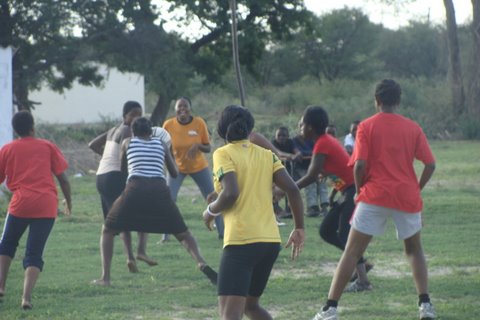 |
| Hosp staff and Teachers netball |
 |
| Little girl from Orphans and Vulnerable Children (OVC) Programme who later recited a poem |
 |
| March past of the Girls and Boys Brigade with the drums from Houston |
Subscribe to:
Posts (Atom)