XIX International AIDS Conference
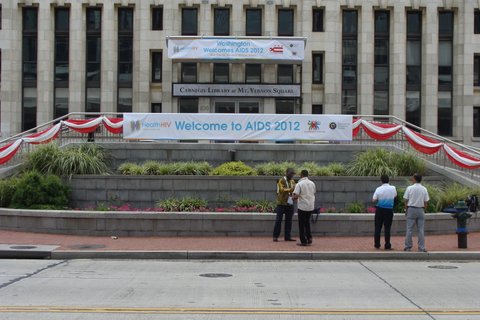
With over 20,000 other participants, Marjorie, Chrisie and Ida gathered in Washington at the XIX International AIDS Conference, for a series of meetings, speeches and other sessions which told of the challenges and successes, the questions and responses in both the lab and in the field. We should be proud that the Church of Scotland, as part of its Mission, has a programme that focuses on HIV prevention, that is working to end discrimination against HIV patients, and that advocates research and investment to make treatment available to all those who need it.
Sunday 22 & Monday 23 July 2012
The M&E Session before the opening was useful in showcasing a solar powered laptop, used for collecting and processing data in remote rural areas.
At the opening, we learned that Zambia’s infection rate has decreased and that more people are able to access ARVs than previously. These are new infections being treated and we are not just treating those waiting in the queue. Proper adherence should ensure people living with HIV can enjoy a more normal, fulfilling and longer quality of life.
Treatment is a form of prevention. This is especially true in the case of PMTCT. If all HIV+ mothers receive ARVs, then the risk of transmission to the child is minimal. Malawi has already gone down this road with good results (Option B+). Zambia is being encouraged by WHO to follow suit. In doing this, the 2015 goal mentioned at the faith-based conference should be reached.
Related to this, is the necessity to upscale our outreach to youth. Too many do not know their status, this is not helped by their exclusion from adult programmes. That is why, at Mwandi, our provision of a Youth-Friendly Corner (and the appointment of a Youth Co-ordinator) has been so important. It will continue to provide quality care, education, testing and easy access to ARVs, for this important segment of the population in the catchment area. Only through this, can stigma be addressed and help offered by peer educators.
The Food Security Session showed how hospitals can work closely with nutritionists to improve the diet of patients. The Nutrition Department prescribe donated food to patients based on their BMI.

However, a significant challenge to be faced is ‘leakage’, ie. the numbers tested and found positive amongst babies, children, youth and adults are far greater than those who actually commence treatment.
On the Sunday afternoon, a large crowd gathered near the Washington Monument as part of the Washington ‘Keep the Promise’ March. Andrew Young and Rev Al Sharpton gave inspiring speeches, setting the stage for some further introspection.
It was also good to see the AIDS Memorial Quilt, that was started by gay rights activists who wanted to make certain that their friends who had died of AIDS would not be forgotten. The quilt is now the largest community art project in the world, and is a poignant testimony to love, peace, and hope. There are men, women and children from every continent, remembered in the panels. It is a wonderful and moving memorial to those who have died, but also a celebration of life.
Tuesday 24 July 2012
Hilary Clinton addressed the plenary session on Tuesday. The first item after that was entitled ‘Science to Public Health’, and discussed the tools necessary to end the epidemic. An AIDS-free generation was the ultimate goal. There was a moral responsibility to ensure this.
Tuesday also saw the opening of the Global Village, which is the focal point for science, medicine, civil society and the wider community. It is a noisy, vibrant and colourful area, with an eclectic array of fringe events and activities.

In the afternoon, an interesting session took place, on the critical and growing role of the faith community in treatment and advocacy, to increase the political will to fight AIDS locally, nationally and internationally. Access, dignity and inclusion are all part of our work for justice. Other meetings Ida attended dealt with developing community support and capacity, remuneration for Home-Based Care workers, and finally Prevention, which brought Tuesday to a close.
Wednesday 25 July
The Wednesday Plenary opened with research on the HIV vaccine and highlighted the effect of the epidemic on children, adolescents and women in particular. Women account for over half the 34 million people living with HIV worldwide, and the rate of infection is twice the male rate in Sub-Saharan Africa.
Ida spent a lot of time learning about finances and the efficient use of funding. She listened to DFID and Global Fund discuss the effect the present financial crisis was having on funding. Other areas of interest were scaling up PMTCT, and learning about the demand and supply side of pharmaceuticals. Ida was honoured to be able to speak about how policy-makers' decisions, and their implementation, affect people at the grassroots level.
Thursday 26 July
The plenary dealt with the dynamics of the epidemic, in particular, contexts with groups most vulnerable to infection, including sex-workers. Expanding testing and treatment, while at the same time ensuring greater adherence and prevention, were some of the approaches suggested. The Global Fund held more public sessions on: political commitment, resources and pricing; a sub-Saharan session on the cancellation of Round 11 grants, and finally a meeting called "The Next Five Years", which outlined the strategic direction and future hopes.

Friday 27 July
The final day’s plenary was concerned with co-infections, including TB and other non-communicable diseases, such as heart disease, cancer and diabetes. We heard that the cost of treating a patient in Zambia is $200 per year. The closing session was addressed by a series of politicians and international worthies, and ended with a keynote address by Bill Clinton.
The XX International AIDS Conference (AIDS 2014) will convene in Melbourne 20-25 July 2014.
One especially memorable highlight for Ida was greeting Kenneth Kaunda on the escalator. He was going down as Ida was going up. We don’t know who was more surprised - Ida, seeing the First President, or Kenneth, being greeted by Ida so far away from home, in a Washington DC Conference Centre in the Lozi manner (Kukandalela)!
 |
| Ida Waddell and Marjorie Clark |
