Showing posts with label Global Fund. Show all posts

Wednesday, 15 August 2012

TURNING THE TIDE TOGETHER


XIX International AIDS Conference

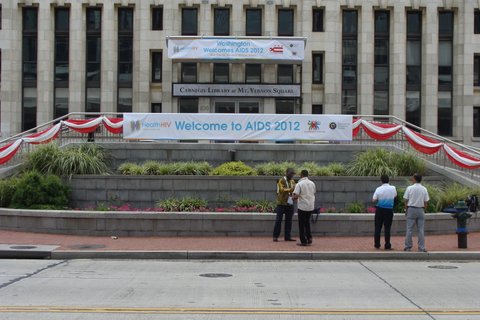
With over 20,000 other participants, Marjorie, Chrisie and Ida gathered in Washington at the XIX International AIDS Conference, for a series of meetings, speeches and other sessions which told of the challenges and successes, the questions and responses in both the lab and in the field. We should be proud that the Church of Scotland, as part of its Mission, has a programme that focuses on HIV prevention, that is working to end discrimination against HIV patients, and that advocates research and investment to make treatment available to all those who need it.

Sunday 22 & Monday 23 July 2012

The M&E Session before the opening was useful in showcasing a solar powered laptop, used for collecting and processing data in remote rural areas.

At the opening, we learned that Zambia’s infection rate has decreased and that more people are able to access ARVs than previously. These are new infections being treated and we are not just treating those waiting in the queue. Proper adherence should ensure people living with HIV can enjoy a more normal, fulfilling and longer quality of life.

Treatment is a form of prevention. This is especially true in the case of PMTCT. If all HIV+ mothers receive ARVs, then the risk of transmission to the child is minimal. Malawi has already gone down this road with good results (Option B+). Zambia is being encouraged by WHO to follow suit. In doing this, the 2015 goal mentioned at the faith-based conference should be reached.

Related to this, is the necessity to upscale our outreach to youth. Too many do not know their status, this is not helped by their exclusion from adult programmes. That is why, at Mwandi, our provision of a Youth-Friendly Corner (and the appointment of a Youth Co-ordinator) has been so important. It will continue to provide quality care, education, testing and easy access to ARVs, for this important segment of the population in the catchment area. Only through this, can stigma be addressed and help offered by peer educators.

The Food Security Session showed how hospitals can work closely with nutritionists to improve the diet of patients. The Nutrition Department prescribe donated food to patients based on their BMI.


However, a significant challenge to be faced is ‘leakage’, ie. the numbers tested and found positive amongst babies, children, youth and adults are far greater than those who actually commence treatment.

On the Sunday afternoon, a large crowd gathered near the Washington Monument as part of the Washington ‘Keep the Promise’ March. Andrew Young and Rev Al Sharpton gave inspiring speeches, setting the stage for some further introspection.

It was also good to see the AIDS Memorial Quilt, that was started by gay rights activists who wanted to make certain that their friends who had died of AIDS would not be forgotten. The quilt is now the largest community art project in the world, and is a poignant testimony to love, peace, and hope.  There are men, women and children from every continent, remembered in the panels. It is a wonderful and moving memorial to those who have died, but also a celebration of life.

Tuesday 24 July 2012

Hilary Clinton addressed the plenary session on Tuesday. The first item after that was entitled ‘Science to Public Health’, and discussed the tools necessary to end the epidemic. An AIDS-free generation was the ultimate goal. There was a moral responsibility to ensure this.

Tuesday also saw the opening of the Global Village, which is the focal point for science, medicine, civil society and the wider community. It is a noisy, vibrant and colourful area, with an eclectic array of fringe events and activities.


In the afternoon, an interesting session took place, on the critical and growing role of the faith community in treatment and advocacy, to increase the political will to fight AIDS locally, nationally and internationally. Access, dignity and inclusion are all part of our work for justice. Other meetings Ida attended dealt with developing community support and capacity, remuneration for Home-Based Care workers, and finally Prevention, which brought Tuesday to a close.

Wednesday 25 July

The Wednesday Plenary opened with research on the HIV vaccine and highlighted the effect of the epidemic on children, adolescents and women in particular. Women account for over half the 34 million people living with HIV worldwide, and the rate of infection is twice the male rate in Sub-Saharan Africa.

Ida spent a lot of time learning about finances and the efficient use of funding. She listened to DFID and Global Fund discuss the effect the present financial crisis was having on funding. Other areas of interest were scaling up PMTCT, and learning about the demand and supply side of pharmaceuticals. Ida was honoured to be able to speak about how policy-makers' decisions, and their implementation, affect people at the grassroots level.

Thursday 26 July

The plenary dealt with the dynamics of the epidemic, in particular, contexts with groups most vulnerable to infection, including sex-workers. Expanding testing and treatment, while at the same time ensuring greater adherence and prevention, were some of the approaches suggested. The Global Fund held more public sessions on:  political commitment, resources and pricing; a sub-Saharan session on the cancellation of Round 11 grants, and finally a meeting called "The Next Five Years", which outlined the strategic direction and future hopes.


Friday 27 July

The final day’s plenary was concerned with co-infections, including TB and other non-communicable diseases, such as heart disease, cancer and diabetes. We heard that the cost of treating a patient in Zambia is $200 per year. The closing session was addressed by a series of politicians and international worthies, and ended with a keynote address by Bill Clinton.

The XX International AIDS Conference (AIDS 2014) will convene in Melbourne 20-25 July 2014.

One especially memorable highlight for Ida was greeting Kenneth Kaunda on the escalator. He was going down as Ida was going up. We don’t know who was more surprised - Ida, seeing the First President, or Kenneth, being greeted by Ida so far away from home, in a Washington DC Conference Centre in the Lozi manner (Kukandalela)!

Ida Waddell and Marjorie Clark
Thanks to the Church of Scotland for their financial and logistical help to make attendance at this conference possible for Ida. Thanks, too, to her old friend, Megan. It was a good time of spiritual, personal and professional development. It was useful and enjoyable spending time with colleagues, and also meeting and speaking with other people from the diverse communities involved in the fight against the epidemic – science, advocacy, faith, politicians and vulnerable populations.

Tuesday, 31 May 2011

Doughville

Following the G8 Summit in Deauville in France, we hear the promise of more transparency by these Governments with their aid. This will involve the quality and outcomes of their aid. There will apparently now be a two-pronged approach: the quantitative reporting of disbursements and also a qualitative approach based on effectiveness, the measurement of results and best practices.

While this is encouraging, Oxfam have accused the G8 of manipulating figures to cover up shortfalls and ignoring inflation. To improve matters it is suggested Governments sign and implement the International Aid Transparency Initiative which provides a common standard for defining and disclosing aid information. This would make it easier to compare aid budgets and projects.

Transparency is vital to ensure that aid reaches where it is supposed to go. It is useful for taxpayers, NGOs and donors to be more efficient and could help expose corruption. It would help ordinary people to track the money – from the donor down to the jotters delivered to the school, or the vaccines to the rural health post. It will also make it difficult for donors not to give what they have promised in the fight against poverty and injustice. In Zambia it would be good to know how much aid the government is receiving, and how it is disbursed. Aid information needs to be comprehensive, comparable, current and accessible.

This week we learned the Zambian government has just received funding of about US $300 million from the Global Fund after the government returned part of the money and promised to pay back the rest of over K9.1 billion that was mismanaged by recipients. These funds were meant for the fight against HIV/AIDS, Malaria and TB.

The re-imbursement of misappropriated funds has been justified by saying Zambia would not have received this new funding had the refund not been not done.But the refund of the misappropriated K9.1 billion to the Global Fund has not come from those who had originally misappropriated the money but from front-line cuts to the Health Budget.

Recent statistics showed that the formal employment sector in Zambia employs only about 10% of the available workforce. With so few formal jobs, small informal businesses such as tailoring, hairdressing or a small grocery stand or tuck-shop known locally as a ‘Kantemba' are run by many families here. Other outlets in Mwandi provide firewood, furniture, vegetables and fishing-nets. Profits from this kind of trade are often small and offer little opportunity to expand the business.

Zambian banks take little interest, though they earn great interest, in lending. The present annual Interest Rate is around 50%. Our nearest bank is in Sesheke over 70km away. The required minimum opening balances range between $150 and $300 depending on the type of account. This is far beyond the reach of most Zambians. Even monthy servicing fees are more than $10. A retired Headmaster we know is charged a K20 000 ‘service fee’ each time he withdraws his monthly pension of K90 000!

With most of the people living on less than a dollar a day, these minimum balances are designed to prevent most people from having access to basic banking services.

More people are instead turning to microfinance institutions (MFIs) which are increasingly becoming more accessible. Two groups, have with American church help, started this month at Mwandi. Unfortunately most people here have still have little choice but to turn to loan sharks.

There are only 25 MFIs registered in Zambia, and the total number of borrowers it is reckoned at less than 100,000. How to make banking services and reasonable credit facilities available and affordable to a majority of Zambians is a problem, but necessary to solve if the economy is to continue to grow and the country develop.

After all this talk of Mammon perhaps a little related linguistic levity is in order, especially for Scottish readers in particular - threats of banker super-injunctions forby. We sometimes get our messages in Katima Mulilo in Namibia which is just across the Zambezi from Sesheke. The two main Banks there rejoice in the names, believe it or not, of ‘FNB’ (Apologies to Matt McGinn!) This officially stands for First National Bank. I leave any locally suggested alternatives to your imagination. The other is called Nedbank! We wonder if this name is a reflection of the corporate leadership or of the clientele

And finally the Chinyanja for ‘No’ – the main language in Eastern Province, is 'Awe' pronounced: Away.

As in away ye go!

Friday, 18 March 2011

Missing Money, Missing Drugs and Missing Jobs

One of the consequences of the suspension of funding to Zambia by the Global Fund to fight AIDS, Tuberculosis and Malaria, has been an increasing number of stock outages and drug rationing that has affected all hospitals nation-wide, Mwandi Mission included.

Stock outages at clinics and hospitals have been so far fairly short term, but Central Medical Stores have sometimes run out of stocks for a considerable period as they wait for emergency shipments to arrive. In cases of low stock levels, drugs are rationed.

Regular readers will remember in an earlier blog the covering of the allegations of corruption at the Zambian Ministry of Health (MoH) uncovered by an investigation by the auditor general. The audit found that the ministry could not account for more than US$7.2 million. The repercussions from this are still being felt.

Another audit undertaken by the Global Fund* reported on poor financial management at the MoH, Ministry of Finance, the Christian Health Association of Zambia (CHAZ) and the Zambian National AIDS Network. These bodies used to receive Global Fund monies directly for programme implementation and then pass funds on to other organisations called sub-recipients. The audit found that $10.7 million of Global Fund money was not passed on and, to date, none of it has been repaid. The alleged financial mismanagement includes the purchase of vehicles for personal use, inflated salaries - sometimes more than double the going–rate locally, and funds disbursed to sub-recipients who could not provide auditors with financial records.

The Global Fund only funds CHAZ directly now; the MoH no longer receives funds, its responsibility in this area has gone to the United Nations Development Programme (UNDP) in Zambia. Teething troubles with these new procedures have brought delays for us on the ground in receiving funding for our AIDS Relief Programme. We have also suffered two major stock-outs of antiretrovirals (ARVs) recently. Fortunately we had a Hospital vehicle in Lusaka at the time that waited for one of the drugs to arrive in the country. We are relying on UNICEF and USAID who are scrambled to bring in more expensive emergency supplies until the new bodies get their procurement procedures properly functioning. TB drugs have also been in short supply. A week’s supply of the children’s ARVs was borrowed from the District Hospital.

The knock-on effects from this was that we could only give a week’s supply which meant the children and parents having another walk in a week’s time to the Clinic to receive the rest of the month’s supply. This meant further unbudgeted transport costs for the rural poor with an increased risk of defaulting and subsequent resistance.

Those responsible for the misuse of funds are still not being held accountable. It will be up to local courts to prosecute those suspected of fraud or the misappropriation of funds. Civil Society and some NGOs are pressing for this. Patients and clients in this area rely on these funds to provide their medication; if there are no drugs available or they are in short supply they need to know why. They have a human right to universal and equitable access.

Linked to this we have four workers facing immediate redundancy. The Government has recently been recruiting mission workers and has put on their payroll some who were formerly paid by CHAZ through a grant from Government which came originally from outside donors. The Government is keeping that grant to pay workers directly. CHAZ workers who are under 45 years of age and in possession of a Grade 12 School leaving Certificate were eligible to apply. The grant to the Hospital to pay the CHAZ workers is being cut in proportion to the number of workers put on Government payroll and linked to the ‘on paper’ establishment. So we now have four over-aged or under-qualified workers with many years of good experience and loyal service who are about to be thrown on the scrap heap as surplus to requirement. The change-over was supposed to be done over time and using where possible natural wastage. The Hospital cannot at the moment generate enough independent income to pay them or pay their retrenchment package.

Like our clients and patients living with HIV and Aids, these four people are another set of victims of the world’s greed and injustice, their dignity in work destroyed. Wealth that has been given generously is not shared fairly but kept in the hands of a few and misused to promote inequality and injustice.

*The full report can be found by googling 'Global Funding Country Audit Zambia'