Showing posts with label Aids. Show all posts

Wednesday, 15 August 2012

TURNING THE TIDE TOGETHER


XIX International AIDS Conference

With over 20,000 other participants, Marjorie, Chrisie and Ida gathered in Washington at the XIX International AIDS Conference, for a series of meetings, speeches and other sessions which told of the challenges and successes, the questions and responses in both the lab and in the field. We should be proud that the Church of Scotland, as part of its Mission, has a programme that focuses on HIV prevention, that is working to end discrimination against HIV patients, and that advocates research and investment to make treatment available to all those who need it.
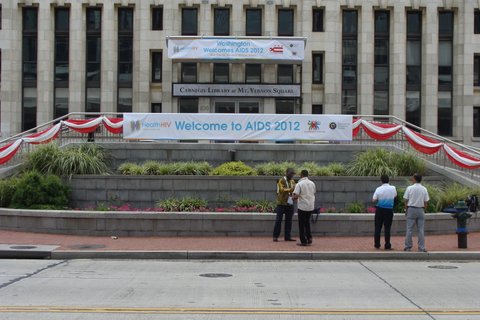

Sunday 22 & Monday 23 July 2012

The M&E Session before the opening was useful in showcasing a solar powered laptop, used for collecting and processing data in remote rural areas.

At the opening, we learned that Zambia’s infection rate has decreased and that more people are able to access ARVs than previously. These are new infections being treated and we are not just treating those waiting in the queue. Proper adherence should ensure people living with HIV can enjoy a more normal, fulfilling and longer quality of life.

Treatment is a form of prevention. This is especially true in the case of PMTCT. If all HIV+ mothers receive ARVs, then the risk of transmission to the child is minimal. Malawi has already gone down this road with good results (Option B+). Zambia is being encouraged by WHO to follow suit. In doing this, the 2015 goal mentioned at the faith-based conference should be reached.

Related to this, is the necessity to upscale our outreach to youth. Too many do not know their status, this is not helped by their exclusion from adult programmes. That is why, at Mwandi, our provision of a Youth-Friendly Corner (and the appointment of a Youth Co-ordinator) has been so important. It will continue to provide quality care, education, testing and easy access to ARVs, for this important segment of the population in the catchment area. Only through this, can stigma be addressed and help offered by peer educators.

The Food Security Session showed how hospitals can work closely with nutritionists to improve the diet of patients. The Nutrition Department prescribe donated food to patients based on their BMI.


However, a significant challenge to be faced is ‘leakage’, ie. the numbers tested and found positive amongst babies, children, youth and adults are far greater than those who actually commence treatment.

On the Sunday afternoon, a large crowd gathered near the Washington Monument as part of the Washington ‘Keep the Promise’ March. Andrew Young and Rev Al Sharpton gave inspiring speeches, setting the stage for some further introspection.

It was also good to see the AIDS Memorial Quilt, that was started by gay rights activists who wanted to make certain that their friends who had died of AIDS would not be forgotten. The quilt is now the largest community art project in the world, and is a poignant testimony to love, peace, and hope.  There are men, women and children from every continent, remembered in the panels. It is a wonderful and moving memorial to those who have died, but also a celebration of life.

Tuesday 24 July 2012

Hilary Clinton addressed the plenary session on Tuesday. The first item after that was entitled ‘Science to Public Health’, and discussed the tools necessary to end the epidemic. An AIDS-free generation was the ultimate goal. There was a moral responsibility to ensure this.

Tuesday also saw the opening of the Global Village, which is the focal point for science, medicine, civil society and the wider community. It is a noisy, vibrant and colourful area, with an eclectic array of fringe events and activities.


In the afternoon, an interesting session took place, on the critical and growing role of the faith community in treatment and advocacy, to increase the political will to fight AIDS locally, nationally and internationally. Access, dignity and inclusion are all part of our work for justice. Other meetings Ida attended dealt with developing community support and capacity, remuneration for Home-Based Care workers, and finally Prevention, which brought Tuesday to a close.

Wednesday 25 July

The Wednesday Plenary opened with research on the HIV vaccine and highlighted the effect of the epidemic on children, adolescents and women in particular. Women account for over half the 34 million people living with HIV worldwide, and the rate of infection is twice the male rate in Sub-Saharan Africa.

Ida spent a lot of time learning about finances and the efficient use of funding. She listened to DFID and Global Fund discuss the effect the present financial crisis was having on funding. Other areas of interest were scaling up PMTCT, and learning about the demand and supply side of pharmaceuticals. Ida was honoured to be able to speak about how policy-makers' decisions, and their implementation, affect people at the grassroots level.

Thursday 26 July

The plenary dealt with the dynamics of the epidemic, in particular, contexts with groups most vulnerable to infection, including sex-workers. Expanding testing and treatment, while at the same time ensuring greater adherence and prevention, were some of the approaches suggested. The Global Fund held more public sessions on:  political commitment, resources and pricing; a sub-Saharan session on the cancellation of Round 11 grants, and finally a meeting called "The Next Five Years", which outlined the strategic direction and future hopes.


Friday 27 July

The final day’s plenary was concerned with co-infections, including TB and other non-communicable diseases, such as heart disease, cancer and diabetes. We heard that the cost of treating a patient in Zambia is $200 per year. The closing session was addressed by a series of politicians and international worthies, and ended with a keynote address by Bill Clinton.

The XX International AIDS Conference (AIDS 2014) will convene in Melbourne 20-25 July 2014.

One especially memorable highlight for Ida was greeting Kenneth Kaunda on the escalator. He was going down as Ida was going up. We don’t know who was more surprised - Ida, seeing the First President, or Kenneth, being greeted by Ida so far away from home, in a Washington DC Conference Centre in the Lozi manner (Kukandalela)!

Ida Waddell and Marjorie Clark
Thanks to the Church of Scotland for their financial and logistical help to make attendance at this conference possible for Ida. Thanks, too, to her old friend, Megan. It was a good time of spiritual, personal and professional development. It was useful and enjoyable spending time with colleagues, and also meeting and speaking with other people from the diverse communities involved in the fight against the epidemic – science, advocacy, faith, politicians and vulnerable populations.

Tuesday, 29 November 2011

Doing More with Less

INTERNATIONAL AIDS DAY - Getting To Zero

Zero new infections, zero discrimination and zero Aids related deaths
(this year's theme)


There is good news from a recent UNAIDS report released for World AIDS Day (1 Dec). www.unaids.org/en/resources/unaidspublication/2011/  New HIV infections and AIDS-related deaths continue to fall, and the number of people on treatment in the less developed world is almost 50 percent of those eligible. This has happened in spite of a decrease in finances.

Especially encouraging for us in Zambia is that access to HIV treatment has improved greatly in Sub-Saharan Africa (SSA), the region which has long been worst hit by the AIDS epidemic, making up some 68 percent or 22.9 million of all HIV-infected people.

Access to antiretroviral drugs (ARVs) has increased in SSA by 1/5 between 2009 and 2010 though 1.2m people still died of AIDS-related causes last year. Zambia has reported coverage levels of between 70 and 80 percent; nearing universal access (considered 80%).

The overall world statistics are encouraging too; while 2.7 million people contracted HIV in 2010. This represents a fall of over 1/5 since 1997.

6.6 million people are now accessing ARVs , an increase of 1.35 million in less than two years. With improved access to treatment, new HIV infections are also declining sharply.

It seems that ARVs play a role in reducing transmission of the virus to partners. Infection rates are 1/3 to ½ fewer than would have been the case without ARVs. This amounts to 2.5m people alive today who would not have otherwise been.

Changes in behaviour such as abstinence, condom-use and male circumcision are also contributing. Prevention of mother-to-child transmission is another success, where 400 000 new infections have been prevented.
To continue to do more with less, the UNAIDS Report suggests a 4- Goal Investment Framework to use funding more efficiently and effectively.

1.Maximise benefits of HIV Response

2.Use national epidemiology to ensure best allocation of resources

3.Implement programmes based on local context

4. Increase efficiency in prevention treatment care and support

This new approach in funding could prevent some 12.2 million new infections - including 1.9 million children, and 7.4 million AIDS-related deaths between now and 2020 says the report.

For universal access to HIV prevention, treatment, care and support by 2015, an estimated US$22-$24 billion annually is required.

In the past two years donor funding has been cut by 10 percent from $7.6 billion in 2009 to $6.9 billion in 2010.

Without stable funding, opportunities to prevent new infections will be missed and there is a risk that the progress gained in the fight against HIV could be lost.

Our Aids Relief Programme at the Mission Hospital here in Mwandi continues with its static clinic based here at the hospital and the 6 mobile outreach clinics. The outreach is now undertaken weekly. There are 1478 people on ART, 164 of whom are children.

We are grateful to many people for being able to look after our clients in many different ways. Starting at the top we have PEPFAR and AIDS Relief with the funding and other structural and logistical support. On the ground here we have a number of Church Partners who help such as IPC with reagents, Aiken and Goldsboro and other individuals for their contribution to the Formula Programme. There are over 250 children alive today who benefited from this programme that uses WHO guide-lines. The Church of Scotland Guild ’s Food Support programme that brings nutritional support to the Hospital and Home-based Care programmes. There are numerous churches and visitors who by buying bags and craft items made by the Mothers’ Support Group give this group a small but steady income throughout the year.

This year in Mwandi the Community will meet as usual on AIDS Day Eve for a candle-lit service in memory of those who are no longer with us and who have been lost to HIV/AIDS. At the service we will have a large number or Orphans and Vulnerable Children, a visible legacy and testimony to the destruction caused to ordinary families by this appalling pandemic. It is a sad and moving occasion but also one of joy and hope in the presence of these children.
The next day, AIDS Day, there will be a march through the village, an all-age gathering for some speeches, songs and drama; a Fun-Run and Football Match are the sporting events planned.

Tuesday, 31 May 2011

Doughville

Following the G8 Summit in Deauville in France, we hear the promise of more transparency by these Governments with their aid. This will involve the quality and outcomes of their aid. There will apparently now be a two-pronged approach: the quantitative reporting of disbursements and also a qualitative approach based on effectiveness, the measurement of results and best practices.

While this is encouraging, Oxfam have accused the G8 of manipulating figures to cover up shortfalls and ignoring inflation. To improve matters it is suggested Governments sign and implement the International Aid Transparency Initiative which provides a common standard for defining and disclosing aid information. This would make it easier to compare aid budgets and projects.

Transparency is vital to ensure that aid reaches where it is supposed to go. It is useful for taxpayers, NGOs and donors to be more efficient and could help expose corruption. It would help ordinary people to track the money – from the donor down to the jotters delivered to the school, or the vaccines to the rural health post. It will also make it difficult for donors not to give what they have promised in the fight against poverty and injustice. In Zambia it would be good to know how much aid the government is receiving, and how it is disbursed. Aid information needs to be comprehensive, comparable, current and accessible.

This week we learned the Zambian government has just received funding of about US $300 million from the Global Fund after the government returned part of the money and promised to pay back the rest of over K9.1 billion that was mismanaged by recipients. These funds were meant for the fight against HIV/AIDS, Malaria and TB.

The re-imbursement of misappropriated funds has been justified by saying Zambia would not have received this new funding had the refund not been not done.But the refund of the misappropriated K9.1 billion to the Global Fund has not come from those who had originally misappropriated the money but from front-line cuts to the Health Budget.

Recent statistics showed that the formal employment sector in Zambia employs only about 10% of the available workforce. With so few formal jobs, small informal businesses such as tailoring, hairdressing or a small grocery stand or tuck-shop known locally as a ‘Kantemba' are run by many families here. Other outlets in Mwandi provide firewood, furniture, vegetables and fishing-nets. Profits from this kind of trade are often small and offer little opportunity to expand the business.

Zambian banks take little interest, though they earn great interest, in lending. The present annual Interest Rate is around 50%. Our nearest bank is in Sesheke over 70km away. The required minimum opening balances range between $150 and $300 depending on the type of account. This is far beyond the reach of most Zambians. Even monthy servicing fees are more than $10. A retired Headmaster we know is charged a K20 000 ‘service fee’ each time he withdraws his monthly pension of K90 000!

With most of the people living on less than a dollar a day, these minimum balances are designed to prevent most people from having access to basic banking services.

More people are instead turning to microfinance institutions (MFIs) which are increasingly becoming more accessible. Two groups, have with American church help, started this month at Mwandi. Unfortunately most people here have still have little choice but to turn to loan sharks.

There are only 25 MFIs registered in Zambia, and the total number of borrowers it is reckoned at less than 100,000. How to make banking services and reasonable credit facilities available and affordable to a majority of Zambians is a problem, but necessary to solve if the economy is to continue to grow and the country develop.

After all this talk of Mammon perhaps a little related linguistic levity is in order, especially for Scottish readers in particular - threats of banker super-injunctions forby. We sometimes get our messages in Katima Mulilo in Namibia which is just across the Zambezi from Sesheke. The two main Banks there rejoice in the names, believe it or not, of ‘FNB’ (Apologies to Matt McGinn!) This officially stands for First National Bank. I leave any locally suggested alternatives to your imagination. The other is called Nedbank! We wonder if this name is a reflection of the corporate leadership or of the clientele

And finally the Chinyanja for ‘No’ – the main language in Eastern Province, is 'Awe' pronounced: Away.

As in away ye go!

Friday, 18 March 2011

Missing Money, Missing Drugs and Missing Jobs

One of the consequences of the suspension of funding to Zambia by the Global Fund to fight AIDS, Tuberculosis and Malaria, has been an increasing number of stock outages and drug rationing that has affected all hospitals nation-wide, Mwandi Mission included.

Stock outages at clinics and hospitals have been so far fairly short term, but Central Medical Stores have sometimes run out of stocks for a considerable period as they wait for emergency shipments to arrive. In cases of low stock levels, drugs are rationed.

Regular readers will remember in an earlier blog the covering of the allegations of corruption at the Zambian Ministry of Health (MoH) uncovered by an investigation by the auditor general. The audit found that the ministry could not account for more than US$7.2 million. The repercussions from this are still being felt.

Another audit undertaken by the Global Fund* reported on poor financial management at the MoH, Ministry of Finance, the Christian Health Association of Zambia (CHAZ) and the Zambian National AIDS Network. These bodies used to receive Global Fund monies directly for programme implementation and then pass funds on to other organisations called sub-recipients. The audit found that $10.7 million of Global Fund money was not passed on and, to date, none of it has been repaid. The alleged financial mismanagement includes the purchase of vehicles for personal use, inflated salaries - sometimes more than double the going–rate locally, and funds disbursed to sub-recipients who could not provide auditors with financial records.

The Global Fund only funds CHAZ directly now; the MoH no longer receives funds, its responsibility in this area has gone to the United Nations Development Programme (UNDP) in Zambia. Teething troubles with these new procedures have brought delays for us on the ground in receiving funding for our AIDS Relief Programme. We have also suffered two major stock-outs of antiretrovirals (ARVs) recently. Fortunately we had a Hospital vehicle in Lusaka at the time that waited for one of the drugs to arrive in the country. We are relying on UNICEF and USAID who are scrambled to bring in more expensive emergency supplies until the new bodies get their procurement procedures properly functioning. TB drugs have also been in short supply. A week’s supply of the children’s ARVs was borrowed from the District Hospital.

The knock-on effects from this was that we could only give a week’s supply which meant the children and parents having another walk in a week’s time to the Clinic to receive the rest of the month’s supply. This meant further unbudgeted transport costs for the rural poor with an increased risk of defaulting and subsequent resistance.

Those responsible for the misuse of funds are still not being held accountable. It will be up to local courts to prosecute those suspected of fraud or the misappropriation of funds. Civil Society and some NGOs are pressing for this. Patients and clients in this area rely on these funds to provide their medication; if there are no drugs available or they are in short supply they need to know why. They have a human right to universal and equitable access.

Linked to this we have four workers facing immediate redundancy. The Government has recently been recruiting mission workers and has put on their payroll some who were formerly paid by CHAZ through a grant from Government which came originally from outside donors. The Government is keeping that grant to pay workers directly. CHAZ workers who are under 45 years of age and in possession of a Grade 12 School leaving Certificate were eligible to apply. The grant to the Hospital to pay the CHAZ workers is being cut in proportion to the number of workers put on Government payroll and linked to the ‘on paper’ establishment. So we now have four over-aged or under-qualified workers with many years of good experience and loyal service who are about to be thrown on the scrap heap as surplus to requirement. The change-over was supposed to be done over time and using where possible natural wastage. The Hospital cannot at the moment generate enough independent income to pay them or pay their retrenchment package.

Like our clients and patients living with HIV and Aids, these four people are another set of victims of the world’s greed and injustice, their dignity in work destroyed. Wealth that has been given generously is not shared fairly but kept in the hands of a few and misused to promote inequality and injustice.

*The full report can be found by googling 'Global Funding Country Audit Zambia'

Tuesday, 7 December 2010

A day in the life ...

On Tuesday morning I received a phone call from the Home Based Care (HBC) Coordinator. One of their clients who was bedridden was refusing to go by taxi to keep her Pre Art appointment at the Hospital. Could I help? I agreed and drove through the village, along the very narrow sandy road between pole and dagga houses with their thatch roofs. Young children came running out to wave and chase the car. I stopped and picked up Lilly the HBC carer for the clients in that area. We drove on together a very short distance.

I knew the client, Namatama, as we had had her in the hospital and recently discharged her. Namatama contracted TB four months ago and was also at that time tested for HIV. Because of the TB she could not start Anti Retroviral Therapy (ARVs). She had also recently been in the hospital suffering from PCP, a lung-disease linked to Aids. The usual dusty and ill-clad children greeted us excitedly. The family rushed around to bring chairs to her tiny mud and thatch house. I went in to a dim room with a metal bed in the middle with a thin mattress and chitenge ‘sheets’ (cotton wraps) barely covering the bed. In the middle was Namatama skeletally lying with her face to the wall. We sat down and gave the traditional Lozi greetings. I got up then and insisted on greeting Namatama. This broke the ice with Namatama. I think most people discuss her rather than include her.

She proudly said that the bedsores that she got in the hospital had healed thanks to Lilly. Then she told me that she was hungry but could not eat the food that the family prepared for her as they kept frying everything and the Nshima (thick maize porridge) the staple was too heavy. The bag of soya that she was given by the project remained unused, as it was too strong for her. We then tried to discuss what she could eat and the answer was nothing. Anything the family offered her just gave her diarrhoea. She said that the ORS which Lilly had given her was making her stronger. I then tried another tack if she could choose what would she most like to eat? I smiled at the answer, a boiled potato. We are probably one of the few homes in Mwandi that has potatoes!

I then broached the subject of her appointment. She said that to ride in the car would be too painful for her lungs. We continued our discussion for a short time longer but Namatama was adamant that she would die if she went back to the clinic. I then frankly told her that if she did not go she would die anyway!
I stood up and said that we would pray but before I prayed would she agree to come back with me to the Hospital? She agreed and then we prayed.

Namatama sat in the front to the Hospital with her younger sister and Lilly in the back. Her real fear was that we would insist that she was admitted to hospital yet again. When we arrived I fast-tracked her to see the clinician. She weighed only 33kg. She had lost 10kgs in a month.

I left Namatama with the Clinician and went home and found some potatoes, carrots and a litre of milk.

As I was going back into the clinic I was stopped by a nurse to say that there was a mother and baby waiting for assessment. Mum had stopped feeding the baby at six months because she was HIV +. The baby was now 8 months looked very small and anaemic. The nurse said there is a slight problem in that she is from Namibia. She had come across the Zambezi in a mukolo (wooden canoe). I still enrolled the baby in the formula program as the border is only a colonial border. The people are all of the same tribe and often have relatives on both sides.

Namatama had had bloods done the CD4 was now 22. The clinician felt that she might not manage to take the ARVs as Namatama had said that the family were going at the moment to their fields to clear and plough all day and they did not believe that she was HIV+. The clinician and myself went and spoke to the Doctor. I put forward my case that Lily could step in and give the medicine in Namatama’s home until Namatama could manage to take it herself. It was agreed that Namatama would start on ARVs. Lily went with Namatama’s sister to the Pharmacy for Adherence Counselling and to learn about the medicine. Lilly herself is HIV+ so she understands. Triumphantly after two and a half hours we brought a tired but serene Namatama home.

A lesson was learnt. The food on the project did not suit everybody. We will have to buy for our clients what is best for them.

I came home in time for my Lozi lesson. The Lozi teacher, a retired English teacher, was waiting patiently for me. We have been translating together a pamphlet in English about TB into Lozi. The teacher then has lunch with us as he too is in need of a meal.

Keith came home from school worried. Kandiana the old folks home has run out of food. The government have not sent any money since August. He had been eking it out since then but there was no money left. Can the Guild project help? Fortunately, over half of the residents are HIV+ so beans , kapenta(dried whitebait) and a few other things are purchased. The Mission Farm promises to supply maize ,eggs and meat. They have also run out of firewood. We had a storm the night before that caused a large branch to fall just missing our car, so at the end of the day there is the sound of axes chopping up the branch and the old people who are able dragging the wood away.

The day is another testimony to the grace and providence of God in our lives here.

(We changed people's names for confidentiality)

Friday, 17 September 2010

On home ground again

We are at present limping our way to Livingstone on a very worn front tyre due to continued suspension problems and after having the problem supposedly rectified in Lusaka. We are to pick up Jennie Chinembiri and George Lind (of the Church of Scotland's World Mission Council) from the airport while doing various items of business for school, manse and hospital.

The Reverend Silishebo has demitted office after 8 years at Mwandi and has been called to the Chaplaincy at the University of Zambia in Lusaka; the Reverend Derek Lubasi who is presently at Coillard Memorial in Livingstone will be inducted shortly as our new minister. There is a flurry of activity cleaning, painting and renovating the manse to welcome the new ‘family’ (Lubasi means family in Silozi.)

We have just spent the past week-end doing another flitting! We have moved into Hippo House – bit of a misnomer as far as size is concerned but we are fortunate to enjoy running water and electricity (most of the time) utilities denied to a large majority of the Zambian population.

Some progress has been made with the house that the Church of Scotland funded with a grant, and that Nick designed and is building. The wooden flooring is being laid at the moment. We hope we can move in before Christmas.

We are beginning to pick up the threads of where we left off. On the first Sunday evening we got back was a very moving service for the sending out of the 10 young people back to their congregations. They had been attending a 4 month Mission Course at the Church run by Percy, the Youth Pastor. They had slept in tents, cooked for themselves and freely contributed their talents and labour to various ministries to be found at the Mission. They had also has their faith challenged and deepened, intellectually and academically too they had a substantial amount of reading and writing to tackle, not just of a theological nature either but also other work needing life skills.

We have had a good and useful couple of days with Jennie and George who were able to get a taste of what we do at the Hospital and School as well as the wider Church work we undertake here. We saw them off on Saturday to Kitwe and Lusaka.

We are now back to ‘auld claes and porridge’. Ida is back to work at the AIDS Relief Programme, she has done the first scrubbing for a Caesar and has been returned her keys and asked to tackle the Central Stores which was neglected in her absence. She is a Also working with the Consistory, helping to establish a home-based care programme.

As for me I have been allocated Grade 8C for Maths and Science and 10A for History. I am at present drafting a proposal to submit to a Church Aid for teacher housing at the High School. We are still putting the finishing touches to the second classroom block and student latrines which were not finished despite efforts on my part to ensure that things should continue in my absence.

Another exciting development hoving into view is the possibility of a Community School at Sikuzu. Sikuzu is a rural community about 8km downstream from Mwandi. The children are prevented from attending school at Mwandi until they can walk the return journey each day. They are usually 8 or 9 years before this happens. So a Grade 1-4 School will be a great boon for them. At present there is a UCZ Pre-school run from the Church.

Thursday, 3 June 2010

Church of Scotland General Assembly

After seven days of meeting, the General Assembly closed on Wednesday last week. It was a good time listening to the debates and meeting up with friends from all over the country. As the Church continues to share and spread the Gospel throughout the world, it is amazing the diverse interests, concerns and needs that this brings to light as people speak and we hear often prophetically about passions shared or pain that we attempt to understand and address.

All this feedback and information is living proof of Paul's metaphor in Romans 12 that in Christ we form one body belonging to each other all with different gifts depending on the grace given us with the further development of that in 1 Cor 12 that we are made up of many parts and as a body there should be no division but we need to show equal concern for each other in each of our own joy, pain and sorrow.

Business started appropriately with the Scottish Bible Society and we heard how the Word of God shapes lives here and overseas, contributing to the work of the Church: we have a vested interest here as Ida's mother worked for the Bible Society for many years.

Friday was another interesting day with the 'Third Article Declaratory' being debated concerning parish-based ministry bringing the ordinances of religion to people nationwide. It was interesting and sobering in the World Mission Council Report to hear from minority-status Christians who suffer for the faith. There were deliverences to raise awareness of this amongst elected politicians from Holyrood, Westminister and Brussels. Another echo of 'If one part suffers........' This was also mirrored at home by the work of Crossreach which includes counselling, addiction help, assisting prisoner families and the care provided for the young the old and the infirm of all ages, - the frail and the rejected.

Morning Service at St Giles' Cathedral was followed later in the day by a special service marking the 450th Anniversary of the Scottish Reformation. A wonderful time of reflection on the influence of the reformation on education and on wider Scottish society. It was a medley of Psalms, Prayer and other Scripture cleverly interwoven with monologues, dramatisations and presentations on the theme.

The overall message similar to that delivered from George MacLeod celebrating the 400th and resonating from 16th century - A Reformed Church is forever to be reformed. In other words to make God alive and relevant for people today. Interesting too that there is no longer the same contraversy over the morality over the possession of nuclear weapons. The Church's position on them and Trident is thankfully unequivocally clear.

Monday was good with a report from the Children's Assembly, not just the future Church but part of the Church here and now. A reform of the Presbyteries is envisaged to make them more responsive and better able to deal with the changing needs of the Church. The Guild and their support of HIV and Aids at home and beyond. Ida spoke here wanting to raise awareness of the impact of HIV and AIDS locally at Mwandi and asking the Church to advocate on their behalf to continue to make a difference to the lives of many living people worldwide with this disease.

We heard the report from the Armed Forces Chaplains who look after the spiritual needs of members of the armed forces and their families wherever they are serving. Not an easy job. There is also need of a ministry for forces personnel once they retire to help them adjust back to civilian life again. Safeguarding children and other vulnerable people and the safe inclusion of sex offenders in Congregations came in the report 'For such is the Kingdom of Heaven.'

The Assembly closed on Wednesday with amongst others the Iona Community Board Report, again another area of personal interest to us, Ida's father helped to roof the Abbey just after the War. It was good to read of the good work being done countering sectarianism and working with young offenders.

Finally, another highlight for us was the address by Mona Siddiqui.

Looking back on all this, the Church at this Assembly has identified its task as not only to get out there and talk about Jesus but also to be someone to speak for the poor, those who are marginalised socially, politically, economically, educationally and medically and in doing this it needs to engage in effective advocacy in partnership with civil society and other faith communities.