Wednesday, 15 August 2012

TURNING THE TIDE TOGETHER


XIX International AIDS Conference

With over 20,000 other participants, Marjorie, Chrisie and Ida gathered in Washington at the XIX International AIDS Conference, for a series of meetings, speeches and other sessions which told of the challenges and successes, the questions and responses in both the lab and in the field. We should be proud that the Church of Scotland, as part of its Mission, has a programme that focuses on HIV prevention, that is working to end discrimination against HIV patients, and that advocates research and investment to make treatment available to all those who need it.
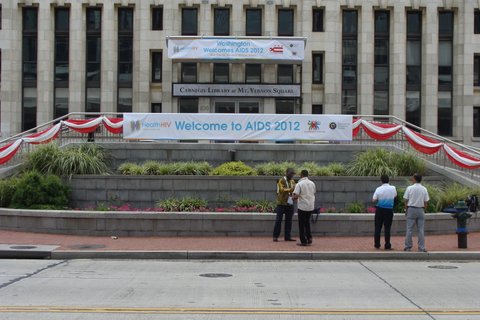

Sunday 22 & Monday 23 July 2012

The M&E Session before the opening was useful in showcasing a solar powered laptop, used for collecting and processing data in remote rural areas.

At the opening, we learned that Zambia’s infection rate has decreased and that more people are able to access ARVs than previously. These are new infections being treated and we are not just treating those waiting in the queue. Proper adherence should ensure people living with HIV can enjoy a more normal, fulfilling and longer quality of life.

Treatment is a form of prevention. This is especially true in the case of PMTCT. If all HIV+ mothers receive ARVs, then the risk of transmission to the child is minimal. Malawi has already gone down this road with good results (Option B+). Zambia is being encouraged by WHO to follow suit. In doing this, the 2015 goal mentioned at the faith-based conference should be reached.

Related to this, is the necessity to upscale our outreach to youth. Too many do not know their status, this is not helped by their exclusion from adult programmes. That is why, at Mwandi, our provision of a Youth-Friendly Corner (and the appointment of a Youth Co-ordinator) has been so important. It will continue to provide quality care, education, testing and easy access to ARVs, for this important segment of the population in the catchment area. Only through this, can stigma be addressed and help offered by peer educators.

The Food Security Session showed how hospitals can work closely with nutritionists to improve the diet of patients. The Nutrition Department prescribe donated food to patients based on their BMI.


However, a significant challenge to be faced is ‘leakage’, ie. the numbers tested and found positive amongst babies, children, youth and adults are far greater than those who actually commence treatment.

On the Sunday afternoon, a large crowd gathered near the Washington Monument as part of the Washington ‘Keep the Promise’ March. Andrew Young and Rev Al Sharpton gave inspiring speeches, setting the stage for some further introspection.

It was also good to see the AIDS Memorial Quilt, that was started by gay rights activists who wanted to make certain that their friends who had died of AIDS would not be forgotten. The quilt is now the largest community art project in the world, and is a poignant testimony to love, peace, and hope.  There are men, women and children from every continent, remembered in the panels. It is a wonderful and moving memorial to those who have died, but also a celebration of life.

Tuesday 24 July 2012

Hilary Clinton addressed the plenary session on Tuesday. The first item after that was entitled ‘Science to Public Health’, and discussed the tools necessary to end the epidemic. An AIDS-free generation was the ultimate goal. There was a moral responsibility to ensure this.

Tuesday also saw the opening of the Global Village, which is the focal point for science, medicine, civil society and the wider community. It is a noisy, vibrant and colourful area, with an eclectic array of fringe events and activities.


In the afternoon, an interesting session took place, on the critical and growing role of the faith community in treatment and advocacy, to increase the political will to fight AIDS locally, nationally and internationally. Access, dignity and inclusion are all part of our work for justice. Other meetings Ida attended dealt with developing community support and capacity, remuneration for Home-Based Care workers, and finally Prevention, which brought Tuesday to a close.

Wednesday 25 July

The Wednesday Plenary opened with research on the HIV vaccine and highlighted the effect of the epidemic on children, adolescents and women in particular. Women account for over half the 34 million people living with HIV worldwide, and the rate of infection is twice the male rate in Sub-Saharan Africa.

Ida spent a lot of time learning about finances and the efficient use of funding. She listened to DFID and Global Fund discuss the effect the present financial crisis was having on funding. Other areas of interest were scaling up PMTCT, and learning about the demand and supply side of pharmaceuticals. Ida was honoured to be able to speak about how policy-makers' decisions, and their implementation, affect people at the grassroots level.

Thursday 26 July

The plenary dealt with the dynamics of the epidemic, in particular, contexts with groups most vulnerable to infection, including sex-workers. Expanding testing and treatment, while at the same time ensuring greater adherence and prevention, were some of the approaches suggested. The Global Fund held more public sessions on:  political commitment, resources and pricing; a sub-Saharan session on the cancellation of Round 11 grants, and finally a meeting called "The Next Five Years", which outlined the strategic direction and future hopes.


Friday 27 July

The final day’s plenary was concerned with co-infections, including TB and other non-communicable diseases, such as heart disease, cancer and diabetes. We heard that the cost of treating a patient in Zambia is $200 per year. The closing session was addressed by a series of politicians and international worthies, and ended with a keynote address by Bill Clinton.

The XX International AIDS Conference (AIDS 2014) will convene in Melbourne 20-25 July 2014.

One especially memorable highlight for Ida was greeting Kenneth Kaunda on the escalator. He was going down as Ida was going up. We don’t know who was more surprised - Ida, seeing the First President, or Kenneth, being greeted by Ida so far away from home, in a Washington DC Conference Centre in the Lozi manner (Kukandalela)!

Ida Waddell and Marjorie Clark
Thanks to the Church of Scotland for their financial and logistical help to make attendance at this conference possible for Ida. Thanks, too, to her old friend, Megan. It was a good time of spiritual, personal and professional development. It was useful and enjoyable spending time with colleagues, and also meeting and speaking with other people from the diverse communities involved in the fight against the epidemic – science, advocacy, faith, politicians and vulnerable populations.

Monday, 6 August 2012

Faith and HIV

Friday, 20 July 2012

The Interfaith Pre-Conference on HIV took place at Howard University in Washington from the 20 and 21 July. Howard University is historically a black college whose graduates played a large part in the Harlem Renaissance and the Civil Rights Movement. Famous alumni include Justice Thurgood Marshall, Stokely Carmichael and Andrew Young, former Ambassador to the UN.

The conference brought together hundreds of religious and community leaders, faith-based representatives, young people and people living with HIV from all over the world under the common theme of health, dignity and justice. I attended this with Marjorie Clark, the Church of Scotland HIV/AIDS Programme Coordinator and Chrisie Morrison, the Communications Officer, from Signposts International.

The first session outlined the faith community’s challenges and opportunities in their work and how to address issues such as stigma,  the President's Emergency Plan for AIDS Relief (PEPFAR) and global funding both during the main conference and on our return home.

From the wide choice of follow-up workshops I chose one on Faith & Stigma organized by the Lutheran Evangelical Church on best practices for building a radically-inclusive faith community. A panel discussed how to help end stigmatization and to develop a welcoming, knowledgeable Church supportive of PLWHA. Stigma needs to be continually challenged in churches and congregations as well as in government and the work-place. Education of lay leaders and the clergy and counselling and conversations around policies that fuel stigma is vital. We, in the UCZ, have needlessly lost too many Church workers through stigma already.

The Lutheran Church invited the Church of Scotland delegates to a reception that was addressed by a Representative from the Global Fund who outlined briefly the new procedures to be undertaken for applying for funds and how they would be disbursed in the future. I commented on how difficult it was to be efficient and effective stewards in the present system, when funding came late and had to be spent quickly.

Later in the afternoon I attended the Catholic Relief Services workshop on addressing the nutritional needs of malnourished clients in HIV programs and making the best use of limited resources. This was useful as we have been recipients of the Guild’s New Hunger Programme. Our response to the unprecedented numbers of malnourished, chronically ill adults was with food assistance programs to affected households through community-based targeting. This was done by supporting the hospital feeding programme and needy patients after discharged, similar to a ‘Food by Prescription’ (FBP) model that focuses on the individual’s nutritional needs as part of their HIV care and treatment program.

The latest development is the nutrition assessment, counseling and support (“NACS”) framework which promotes the “nutrition assessment and counselling for all HIV clients, supported by specialized commodities for rehabilitation as required.” For the integration of NACS into HIV care and treatment services and for it to work, it will require careful consideration of our budget, clients, staffing capacities and infrastructure. The workshop gave an overview of the components of NACS, the thinking behind NACS and a useful look at a more cost-effective design, implementation, monitoring and evaluation.


Saturday 21 July 2012

Today at the morning plenary we were reminded that universal access to prevention, treatment, care and support was supposed to be realized by the end of 2010. However, presently only 50% of people needing anti-retroviral treatment (ART) have access to it. Studies have shown that successful treatment can prevent new HIV infections and the UN pledged to end vertical transmission of HIV by 2015.

The further scale-up of ART and access to affordable ARVs for adults and children still seems to be a challenge especially as regards long-term funding. There appear also to be patent and trade-related issues. A possible solution mentioned was the Medicines Patent Pool (MPP) as one concrete way to facilitate long-term treatment in resource-poor settings in the future.

As was mentioned above there is an exciting plan to eliminate new HIV infections in children and to keep these mothers alive. This was the final workshop I went to. Mission Hospitals are in the frontline in the battle to eliminate new HIV infections in children as well as reducing maternal mortality. Our program for prevention of mother to child transmission (PMTCT) have good practices that provide comprehensive services according to the 4-pronged approach as outlined in the UNAIDS Global Report. Only if our doctors, midwives and other health workers continue to provide good antenatal, obstetric and post-natal care will maternal mortality be reduced.

Finally, in the closing sessions speakers made it is clear that more needs to be done to address the social injustices exposed by HIV and AIDS, including poverty and gender inequality. Faith communities and faith-based organizations can reach most easily those most affected by HIV. In addition to spiritual guidance, we also provide community-wide health, education and social services inspired by our faith that seeks equality, dignity and justice for all.

Tuesday, 10 July 2012

Out of Africa


We left Livingstone to go on furlough on the Pronet flight to Lusaka on 11 June. These flights now allow the same weight allowance as international flights, so there is no need now to fly to Europe via Johannesburg or Nairobi. Up until now these two airports had enjoyed a cosy duopoly, as the two regional hubs, feeding intercontinental flights out of Africa. The only direct flight from Zambia to London was by BA and their fares were not always the cheapest. We always felt guilty flying South to Jo’burg only to fly North again. Although monetarily cheaper this was increasing our carbon foot-print considerably. The Zambian Government have the objective to renovate the airport in Lusaka so that it can hold its own as another hub with a greater number of direct intercontinental destinations.

From Lusaka we flew to Dubai because from there we could fly directly to Glasgow. The city of Dubai is a modern man-made steel and concrete confection built around the combustion engine and cheap fuel. A small port and fort at the mouth of a tidal creek, whose main economic activities historically were trade and pearl-fishing, Dubai was gradually transformed over the past 50 years. Out of the desert sand grew a city based on oil and using the oil money funded a huge construction industry, real estate, tourism and financial services. This has led predictably to the customary greed, property speculation and sleaze you find everywhere.

It is a city of contrasts. Along the banks of the creek are the towering skyscrapers, housing banks and diplomatic missions. They look down on the traditional forts and buildings of the old Dubai. In the malls and the souks, designer labels, white kanduras and black abayas are found side by side. In the harbour, the abras and dhows are berthed alongside the luxury yachts, lavish liners and super-tankers.

The Metro, Monorail and buses run alongside and compete with taxis – the most common form of public transport. The climate is hot and arid with an uncomfortable humidity at this time of year but inside everywhere is air-conditioned. In the shopping centres crass consumerism and consumption prevail with opulent boutiques, gold, jewellery and bling stores, all manner of electronic shops, international renowned supermarkets and department stores crammed with food, clothes and goods from a host of world-wide sources. As regards eating out you can choose from the familiar fast-food chains all the way up to Michelin-starred fine dining. The cuisines available are mainly European, Asian and Arab.

Constitutionally Dubai is an absolute monarchy tempered by a written constitution, a hard-nosed oligarchical family business alleviated by the tribally-rooted Bedouin custom of face to face meetings with the customary authorities and leaders. This society and its economy are serviced by legions of foreign guest-workers of diverse races, languages, cultures and classes who amount to 85% of the population. Of these 70% are Asian and 2/3 of them come from the Indian sub-continent. Our three bus and taxi drivers were either Indian or Pakistani; the chambermaid was Filipino. Most of these Asian workers undertake the menial and manual tasks that locals and others shun.
These people are often exploited and live in hostels, euphemistically rejoicing in the name of ‘collective labour accommodation’, remitting a large proportion of their wages home.

Despite the Arab Spring elsewhere in the region, there has been little meaningful reform in Dubai, and media content that might upset cultural or political sensibilities is carefully monitored and controlled. Any political activism or dissent is vigorously discouraged.

We overnighted in Dubai and caught the plane to Glasgow the next day. We arrived at lunchtime and were met by Stuart who took us to see Kirsten and Iona. Iona, our second grand-daughter, had been born the day before at the Southern General or the “Suffering General” as Glaswegians affectionately term it.

Just before we left Lusaka Ida texted Kirsten to ask if all was quiet with the baby and it was. However, when we got to Dubai, Ruairidh phoned to say that Kirsten had given birth to a little daughter and all was well . It is shows how interconnected our world now is. Ruairidh phones us from Zambia to tell us in Dubai that we have a new granddaughter born in Scotland! Catriona Eilidh is her official name but will be called Iona to distinguish her from our own Catriona. She was a bit jaundiced so had to go back in to hospital for a few days but was soon released again so Ida went through to Glasgow to help Kirsten get established with the new baby. All is now well with Iona growing well and putting on weight. Catriona is going to help her sister now she has finished school. We moved her into her flat, in believe it or not Waddell Court, yesterday and spent the day with Kirsten, Stuart and Iona.

We are safely and comfortably settled in our furlough house. It is in a beautiful situation. At the front we look out onto the Braid Burn that flows through the Craigmillar Golf Course on the side of Blackford Hill and behind us we have the Braid Hills. On a clear day we look over to Arthur’s Seat but the continual rains, drizzle and mist have obscured it for most of the time. Although living in part of Edinburgh we are not entirely cut off from the bush and wildlife. There is an amazing amount of the Scottish urban variety from our window, we have seen deer, doos (pigeons), pheasants and rabbits and a large grey heron who apparently successfully fishes the Braid Burn when it is not in spate.

Retreat

All the Church of Scotland Mission Partners and their families based in Malawi and Zambia recently met together at a lodge outside Livingstone for a three day Retreat – a wonderful time of contemplation, conversation and celebration. A number of us are ecumenical appointments shared by both the Church of Scotland and Methodists. This event was well-planned and organized by Jennie and George, the African and Caribbean Secretary and outgoing Africa Committee Convenor at World Mission.

We arrived from all the airpots on the Thursday afternoon at the venue situated in Mopani forest, a few miles inland from the Victoria Falls, a quiet, idyllic and restful spot. Though, saying that, we were woken each morning by the roars of the lions from the neighbouring plot where lions are being bred for later reintroduction to the wild.

This time out was reminiscent of that time we read of in the Bible, when the early Church just after Pentecost enjoyed a special time of fellowship and sharing, teaching and the breaking of bread together. We were able to get to know each other better and support and encourage one another, a time of both stimulation and refreshment. Despite the age range there was a good family atmosphere.

There were good times where we ministered to each other during twice daily devotions, Church on Sunday and an intimate family Communion Service where we felt very close to God and one another. We are now used to worship in the vernacular so it was good to have this time in English only.

There were good social times as well, a meal out, visiting the local game-park together and the Victoria Falls (Mosi-oa-Tunya – the smoke that thunders). The highlights were seeing the rhinos with the ZAWA Scouts and all getting soaked at the Falls.

The retreat ended all too quickly on the Monday morning but all were convinced of its value and wanted a similar event again in the future.

Tuesday, 15 May 2012

A Healthy Constitution

This week, on Wednesday, as a supplement in ‘The Post” newspaper, the draft of the new Zambian Constitution was published. It is considered by many to be a progressive document and seems to be enjoying fairly widespread support. It is very similar to the one that appeared a few years ago which Senior Chief Inyambo Yeta, who along with others were instrumental in drafting. That document was unfortunately amended beyond all recognition by a previously appointed national constitutional council.


A major concern here in Western Province is that still no recognition is given to Barotseland’s historical role in the formation of the Republic of Zambia. However, as in other democratic constitutions, there is the clear separation of powers. These have been distributed amongst the executive, the judiciary and the legislature to create checks and balances and to ensure accountability to the people.


The new constitution entrenches a Bill of Rights with more rights for women, children, youth, the disabled and the elderly than before and includes affirmative action in certain areas of discrimination and lack of equity. There are also guaranteed economic, social, and cultural rights and a constitutional court. This court would deal with human rights, governance and election issues. A strengthened Human Rights Commission would also be provided with powers to redress human rights violations.


A number of Articles would be entrenched rights and difficult to change. In the past Amendments to the Constitution had been used by some incumbent Presidents to ‘fix’ opponents. To elect the President a 50 per cent plus one vote is required. The Vice President would now need to be elected as a running mate and no longer appointed.


Other proposals are a proportional representation system of electing MPs instead of the present Westminster-style first past the post elections. Cabinet ministers may be appointed from outside the National Assembly. There would be greater devolved and decentralised government at Provincial level. To ensure greater impartiality, traditional rulers and chiefs would be barred from actively participating in party politics.


There will now be a public consultation process lasting 40 days at district, provincial and national level. Local communities through schools, churches and other social groupings are invited to comment. Finally the amended document will be put to a national referendum.


The draft Constitution has also been posted on the website, www.zambianconstitution.org, for people to read and comment on.


On a personal note we are pleased that dual nationality would be permitted, meaning that Mubita could keep his Zambian citizenship which he lost after being adopted by us.


On Saturday 14 and Sunday15 April the UCZ here in the Western Presbytery had a weekend of prayer and fasting to intercede for the Church, Western Presbytery, Western Province, the Zambian Government and the Barotse Royal Establishment focusing on peace and unity.


Friday, 27 April 2012

Farewell to Princess Nakatindi

The Rev Manda, Mrs Manda, Ida and I set out on Saturday morning to Nawinda, the country residence of Princess Nakatindi, who had died after a heart operation on Maundy Thursday in hospital in South Africa. Nawinda is about 10km north-east of Mwandi. Her body had been flown to Lusaka a week later to a State Funeral at the Anglican Cathedral of the Holy Cross. She was accorded this honour in recognition of her contribution to democracy and national development. She also gained the sobriquet ‘the People’s Princess’. After the service in Lusaka, she was flown to Sesheke for burial at home.

We arrived in the midst of all the final preparations for the interment and found seats under one of the marquee and tarpaulin shelters. We sat down on some chairs which had yet to be set out in rows, our neighbours were siziba-clad, red-bereted indunas from the Barotse Royal Establishment.

Already gathering as well were the Mwandi Church choirs, the UCZ, Catholic and New Apostolic. The political cadres were assembling too, the men dressed in chitenge shirts and the women wearing chitenge wraps all in their party colours . Interestingly the Movement for Multiparty Democracy, the Patriotic Front, United Party for National Development each had its own choir and they were rehearsing too.

The digging of the grave in the family cemetery about 200m from the house was underway and interestingly much of the manual work was undertaken by trusted prisoners in their green fatigues from the jail at Sesheke who worked together with the Army, Airforce, Police and National Service personnel, who in turn were advised by indunas. A kayatwa, used at royal burials but echoing the temporary shelter made of reed mats used by herdsmen and paddlers in open country was being made. This would be put over the coffin and buried as well. In the meantime we were served a bread roll and hot sweet tea, a welcome breakfast, as we chatted to other mourners and acquaintances.

The Church had lent all its pews for the occasion, they had been collected by an army truck earlier and were now being unloaded. It was discovered that the lectern had been forgotten. Ida and I dashed back in the car with the Church caretaker, Mr Ndopu, to pick it up. By mid-day all the seating arrangements according to precedence and protocol had been completed and we awaited the arrival of Senior Government Officials, Members of the Cabinet and Parliament and other politicians.

The burial service began around 1500h as the Princess’ body, coffin draped in the Zambian flag, was carried by military pall-bearers, accompanied by the Airforce Brass Band to the entrance porch of the house where it was placed for the body-viewing. This is a custom where everyone present at the funeral may file past the body to bid the deceased a final farewell. The body-viewing must have taken the best part of an hour.
The Minister officiating at the burial was Major (Rev) Malcolm Moffatt Nyambe, the Airforce Chaplain, based at Livingstone. The programme began with a hymn and prayer followed by the lowering of the coffin into the grave and the committal. A firing party released three volleys in salute.Each choir was then given the chance in turn to perform, during the proceedings. After the burial came the laying of wreaths, this was led by Mr Sikota Wina, the widower.

Then came the eulogies, the first was given by the Leader of the Opposition in Parliament, Mr Felix Mutati, then came the Minister of Foreign Affairs and Tourism Given Lubinda, who represented the President. Mr Lubinda is a nephew to Mr Wina.
Also in attendance was Mrs Mazoka, the widow of Anderson, the first President of UPND. The programme closed with the Benediction.

Princess Nakatindi Wina , nee Mirriam Mbololwa Nganga, was born on 15th February 1945 to Yuyi Nganga and Princess Nakatindi Yeta. She was the first of eleven children and is also a cousin to our Senior Chief Inyambo Yeta. She took the name Nakatindi after her mother’s death in 1972. The name Nakatindi comes from matindi - the islands of grass that break off from the river bank when the water is high.

She attended Barotse National School in Mongu and Maramba Girls Secondary School in Livingstone. She then studied accounts at Evelyn Hone College and later studied Business Administration in Britain. In 1967 she married Sikota Wina, they were a devoted couple and had 5 children together.

A freedom fighter, she was the first female Member of Parliament after independence in UNIP but became a founding member of the MMD whose victory at the polls in 1991 brought about the end of the one-party state. Elected as the member for Sesheke, she served as Minister for Tourism, then Community Development in the Chiluba Government but was unjustly detained without trial for over a year following the alleged coup attempt in 1997. She bore no grudge against Dr Chiluba for this and freely forgave him.

As a fearless democrat, advocate of gender equality and women’s emancipation, she boycotted sessions of the Africa Union Parliament because of the lack of female representation and participation in that body. She was a strong voice for the poor and down-trodden and finally served as UPND MP for Kanyama, an impoverished compound in Lusaka.

She is survived by her husband and five children.

Wednesday, 4 April 2012

Dialogue

On Monday the Lozi Prime Minister (Ngambela), Clement Sinyinda, was reported by ZNBC to have said that the Barotse leadership has opted for dialogue with the Zambian Government in the interest of peace and unity. He hinted that a surprising but amicable settlement was in store.

Barotseland had been declared an independent State last week by the Barotse National Council (BNC). This had followed claims of the continuing abrogation of the Barotseland Agreement of 1964 by successive Zambian governments with ensuing neglect and underdevelopment. The BA of 1964 was the Agreement that brought Barotseland and Northern Rhodesia together to form independent Zambia.

The Zambian Justice Minister Sebastian Zulu also interviewed said the Zambian Government is keen to resolve this matter and to keep searching for a peaceful solution.
The First Zambian President, Kenneth Kaunda, who originally signed the Barotseland Agreement of 1964 on behalf of the Zambian Government, appealed to all involved to cooperate and safeguard peace and harmony in the country.

Three church bodies, the Zambia Episcopal Conference (ZEC), Evangelical Fellowship of Zambia (EFZ) and the Council of Churches in Zambia (CCZ) have also called on the Government to create conditions that would facilitate meaningful dialogue and reconciliation among the people of Western Province.

They suggest using the recently-published Chongwe Commission of Inquiry’s Report as a basis for the dialogue. The Church leaders said Government had vacillated and skirted around the issue of the Barotseland Agreement for far too long and it was a problem that would not go away. The Government should engage the Barotse Royal Establishment (BRE) in serious and sincere dialogue on the issues surrounding the Barotseland Agreement of 1964.

With goodwill on both sides, a win-win solution is possible but labelling people as traitors, anarchists or secessionists would only lead to further radicalization and fail to create the necessary conditions for reconciliation. People should use a language which would build up and not destroy.The Government certainly had a duty to maintain law and order and to protect life and property but this duty should be exercised using judgement, sensitivity and due diligence.

The Churches also appealed to Barotse activist groups, particularly the Linyungandambo, Barotse Freedom Movement (BFM), Movement for the Restoration of the Barotseland Agreement (MOREBA) to consider giving dialogue a chance. There was no political issue that could not be resolved through dialogue, so the Church was appealing to all involved to support initiatives which would lead to unity, peace and reconciliation in the country.The Church offered itself as a go-between as it had done previously with the constitutional impasse which eventually led to multi-party democracy in 1991.
Finally they commended the people of Western Province for holding the recent BNC meeting in a transparent and peaceful atmosphere