Friday, 2 December 2011

Photos from World Aids Day


Choir with traditional Instruments

Group of footballers Injectors (Hospital) were playing the Chalk breakers (Teachers) the Hospital won at football and the teachers won at Netball

High school pupils Traditional Dancing

Hosp staff and Teachers netball

Little girl from Orphans and Vulnerable Children (OVC) Programme who later recited a poem

March past of the Girls and Boys Brigade with the drums from Houston

Tuesday, 29 November 2011

Doing More with Less

INTERNATIONAL AIDS DAY - Getting To Zero

Zero new infections, zero discrimination and zero Aids related deaths
(this year's theme)


There is good news from a recent UNAIDS report released for World AIDS Day (1 Dec). www.unaids.org/en/resources/unaidspublication/2011/  New HIV infections and AIDS-related deaths continue to fall, and the number of people on treatment in the less developed world is almost 50 percent of those eligible. This has happened in spite of a decrease in finances.

Especially encouraging for us in Zambia is that access to HIV treatment has improved greatly in Sub-Saharan Africa (SSA), the region which has long been worst hit by the AIDS epidemic, making up some 68 percent or 22.9 million of all HIV-infected people.

Access to antiretroviral drugs (ARVs) has increased in SSA by 1/5 between 2009 and 2010 though 1.2m people still died of AIDS-related causes last year. Zambia has reported coverage levels of between 70 and 80 percent; nearing universal access (considered 80%).

The overall world statistics are encouraging too; while 2.7 million people contracted HIV in 2010. This represents a fall of over 1/5 since 1997.

6.6 million people are now accessing ARVs , an increase of 1.35 million in less than two years. With improved access to treatment, new HIV infections are also declining sharply.

It seems that ARVs play a role in reducing transmission of the virus to partners. Infection rates are 1/3 to ½ fewer than would have been the case without ARVs. This amounts to 2.5m people alive today who would not have otherwise been.

Changes in behaviour such as abstinence, condom-use and male circumcision are also contributing. Prevention of mother-to-child transmission is another success, where 400 000 new infections have been prevented.
To continue to do more with less, the UNAIDS Report suggests a 4- Goal Investment Framework to use funding more efficiently and effectively.

1.Maximise benefits of HIV Response

2.Use national epidemiology to ensure best allocation of resources

3.Implement programmes based on local context

4. Increase efficiency in prevention treatment care and support

This new approach in funding could prevent some 12.2 million new infections - including 1.9 million children, and 7.4 million AIDS-related deaths between now and 2020 says the report.

For universal access to HIV prevention, treatment, care and support by 2015, an estimated US$22-$24 billion annually is required.

In the past two years donor funding has been cut by 10 percent from $7.6 billion in 2009 to $6.9 billion in 2010.

Without stable funding, opportunities to prevent new infections will be missed and there is a risk that the progress gained in the fight against HIV could be lost.

Our Aids Relief Programme at the Mission Hospital here in Mwandi continues with its static clinic based here at the hospital and the 6 mobile outreach clinics. The outreach is now undertaken weekly. There are 1478 people on ART, 164 of whom are children.

We are grateful to many people for being able to look after our clients in many different ways. Starting at the top we have PEPFAR and AIDS Relief with the funding and other structural and logistical support. On the ground here we have a number of Church Partners who help such as IPC with reagents, Aiken and Goldsboro and other individuals for their contribution to the Formula Programme. There are over 250 children alive today who benefited from this programme that uses WHO guide-lines. The Church of Scotland Guild ’s Food Support programme that brings nutritional support to the Hospital and Home-based Care programmes. There are numerous churches and visitors who by buying bags and craft items made by the Mothers’ Support Group give this group a small but steady income throughout the year.

This year in Mwandi the Community will meet as usual on AIDS Day Eve for a candle-lit service in memory of those who are no longer with us and who have been lost to HIV/AIDS. At the service we will have a large number or Orphans and Vulnerable Children, a visible legacy and testimony to the destruction caused to ordinary families by this appalling pandemic. It is a sad and moving occasion but also one of joy and hope in the presence of these children.
The next day, AIDS Day, there will be a march through the village, an all-age gathering for some speeches, songs and drama; a Fun-Run and Football Match are the sporting events planned.

Tuesday, 15 November 2011

Dedication of the new church at Mabumbu

We were invited this Sunday to attend and take part in the Dedication Service for the new church at Mabumbu. I suppose we should be careful in using the word ‘new’. Mabumbu Congregation is a long-established church from Paris Mission times. Infact, Mabumbu meaning ‘the groves’, is named after an older Mabumbu to be found nearer Mongu.

Mabumbu is about 30 minutes from Mwandi. The road is still easily passable, though sandy and dusty. The daytime temperatures are fierce, around 40C, at the moment, as we await the frontal rains from Congo. There have been the odd few spits and drops but that has been convectional. The trees have shot new green leaves in expectation of the coming rains and most people have prepared their fields for sowing. A few courageous individuals have even sown a ‘lima’ or two, gambling on the arrival of the rains in the next week or so. Mubita’s Aunt last week came to say good-bye to us as she was leaving the cattle and fishing camp at the river and returning home to Kakulwani to prepare her fields.

After leaving the tarred road the first major settlement is the village of Namango. It is a typical rural village with daub and wattle houses, thatched roofs and reed-fenced lapas and is situated in a sandy clearing, scattered with baobabs, local palms and other indigenous, deciduous trees that provide wild fruit and shade. Traditionally Namango was the village where our Senior Chief had his fields. At this time of year the Palace moved to Namango for the sowing and the fields were tended by his wife. In the middle of the village we passed the ‘lutaitai’ the special thatch shelter built for the Senior Chief to sit in on arrival and hear submissions from local people needing his help. The Chief stays in Namango at his Kwandu (residence) for a week during the sowing, but his wife will stay longer if required. At Namongo there is also a full Kuta (Court) with its own Indunas.

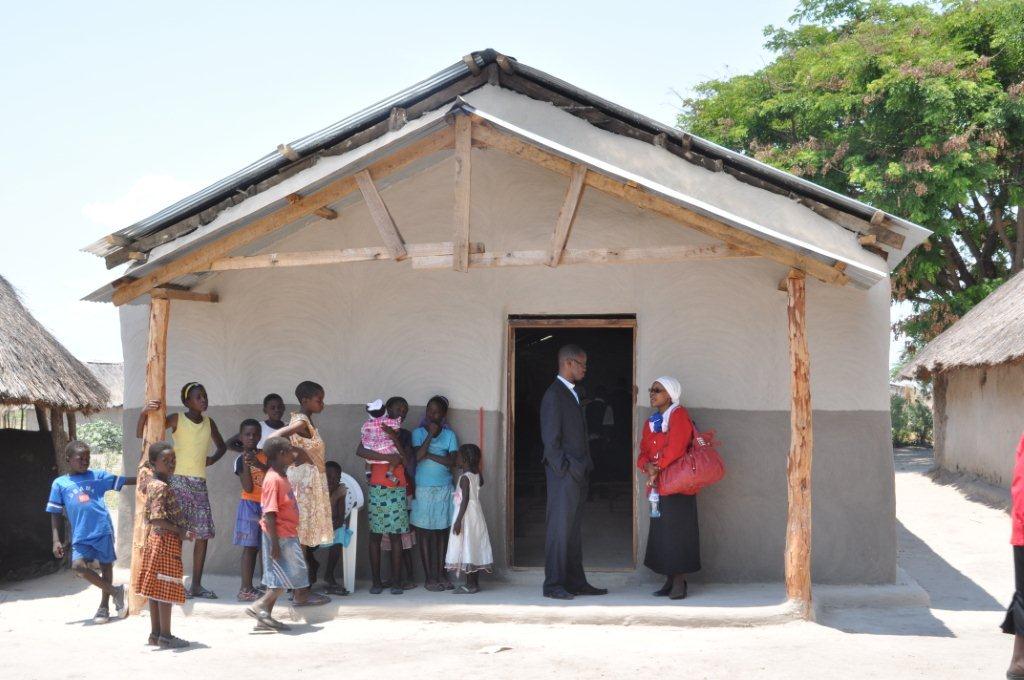
The party from Mwandi arrived at Mabumbu to a warm welcome from the excited congregation. A beautiful and well-built daub and wattle sanctuary and vestry had been constructed and roofed by 70 zinc corrugated sheets. It had been completed in September taking about 12 months to build; the rafters costing K1.6m and the roofing sheets K4.2m (around GBP800/US$1200). The PC(USA) Church in Albemarle helped with the purchase of the sheets, and were thanked and remembered in prayer. The former thatched Church is being retained as a Church Hall. Future plans include the purchase of a new Communion Table and more congregational benches.

The Convenor, Lewis Banda, is supported by an Eldership of 8 men and women drawn from 3 Alume (MCF) and 15 Anamoyo (WCF). This lively and growing 215 member congregation is divided into 4 Sections and all live within a 10km of the Church. The Church is a focal point of the community and has a Sunday School attendance of around 48 most weeks and its Jericho Choir a membership of 18+.

There was a certain familiarity to the Dedication Service as it followed the Scottish Common Order to a great extent with the Opening of the Doors and ‘Ye Gates’ from Psalm 24 to begin with, then the Offering of the Keys. The prayers and readings were shared out amongst the eldership and Consistory visitors including us.

After the Dedication of the Church and its furnishings we moved on to the Proclamation, Scripture Reading and the Sermon based on Matthew 21:12-17, concerning the cleansing of the Temple by Jesus. Rev Manda said while it was important to keep the Church building clean, sweeping out the dirt and re-arranging the furniture was not enough, God’s House is to be a House of Prayer for all, not a den of thieves, we were not in Church to be in business for ourselves. Our bodies as Temples of the Holy Spirit needed to be kept clean too, so that all who entered the new building would be blessed. In other words our business as a Church is outreach to others.

After the Restoration of a Backslider we moved into Holy Communion, served in the French way in a horse-shoe formation round the Table. This was followed by the closing hymn and Benediction.

The Congregation gathered on reed mats under the trees in the Church yard to cook a bring-and-share lunch. The Rev and Mrs Manda, other Consistory visitors, the Uniting Church of Australia visitors and ourselves were served in the vestry. We enjoyed fried chicken, fish, gravy and buhobe. Outside the congregation cooked in their sections mainly reconstituted dried fish stew and mangambwa (pumpkin leaves cooked as greens). At the moment there is little grazing available so there was no mabisi (thick sour milk), only a small amount of fresh milk was available. Maheu from a plastic bucket was the drink on offer. Commercially-produced maheu and mabisi can be bought now in town for those urban Lozis pining for the rural food of their childhood. Maheu is made from left-over porridge to which water and flour is added and left overnight to make a refreshingly tart drink. Sugar can be stirred into it for those with a sweeter tooth.

Monday, 31 October 2011

Matters of Life and Death

Banji ni lumbu, kuilu ni ku mundi  (This world is a cattle camp, the homestead is in heaven.)

This old Lozi proverb emphasises the transience of life and demonstrates that is a universal theme. The ephemeral nature of human life on Earth with our short entry into and exit from this world is a matter all cultures seem to try to come to terms with.

A cattle camp is a group of temporary wooden and grass shelters built on seasonal pastures. The herdsmen live there while they are looking after the cattle. The closest Scottish rural equivalent from yesteryear would be the ‘bothy’. At the moment there are many of these camps at the riverside around Mwandi as the cattle graze on the islands and floodplains. With the onset of the rains these ‘bothies’ will shortly be abandoned and the herds and herdmen will return to the village or homestead -the permanent settlement. It is this transhumance that is being compared to dying person leaving this world for an eternity in heaven.

On Wednesday evening we received news that Rev Manyando’s father had passed away in Mongu. Rev Manyando is one of our Livingstone Ministers. His father, Mr Green Sitali Manyando, was a former teacher, a former Council Chairman for the District and Village Headman. He was 80 years of age and had been ill for the last 8 months.  So on Thursday lunch-time we set off for the Manyando homestead in rural Bulozi, at Litoya, about half-way between Mongu and Senanga. Rev Manda, Getrude Kambole, the Consistory Secretary, Ida, Keith and Mubita  were the Mwandi Representatives. We picked up Rev and Mrs Nyambe in Sesheke and drove up the back road, reaching the pontoon in good time and then visiting the manse in Senanga. We finally arrived at Litoya at around 2200h.

We were welcomed into a dim and crowded lapa. (courtyard surrounded by reeds). As is the Zambian custom, a substantial marquee, made from a large tarpaulin, had been erected in the yard, and in front of it, the usual three-logged campfire was burning. The sofas and armchairs and any other extra seats from the home or borrowed from neighbours were placed outside for the use of visitors, mourners and those coming to pay condolences.

The lapa, at this time, is traditionally split into male and female areas. The men generally sit on the seats under the tent and the ladies in chitenges, legs straight and out-stretched on reed floor-mats. On arrival at the mourning-house (Zambian-English: the dead person’s home) you are expected to shake hands with all present, then enter the main house where the widow and her entourage of female relatives and neighbours are again sitting on mats. There you shake hands and express your sorrow and this is the time for tears. If the bereaved are Christian, you may be asked to offer a prayer of consolation here. You then return outside and sit with the other visitors who have also come to express solidarity with the family in their time of grief. You may now chat and discuss lighter matters with the people around you.

We were offered some of those ubiquitous white plastic garden chairs in front of the main house and a wooden coffee table was placed in our midst. A daughter of the house brought water, soap and a towel to wash our hands before eating. Then we were offered chunks of stewed beef and liver cooked in gravy and buhobe ( thick mealie-meal porridge). Eaten with your fingers, this was most welcome after our day’s journey. Cool drinking water is always served after eating. It is a breach of etiquette to drink with your meal as Europeans would tend to do.   

It was exceptionally atmospheric after eating to sit and look up at a clear night sky with its tiny electric blue spangles of glittering stars in their constellations, smell the whiffs of woodsmoke and listen to singing of hymns and choruses accompanied too by the rhythmic cadences of the drumming of youngsters from the Church choir.

Most people wrapped themselves in blankets or chitenges and settled down to sleep after midnight, others kept watch and dozed on and off throughout the night. The night-time temperature at this time of year does not fall below the mid-20s Centigrade. We three were very kindly given the privacy of an igloo-tent pitched in the lapa; inside too was the luxury of a mattress. Our middle-aged bones are no longer as good as they once were for sleeping directly on the ground! Incidentally we used our bath-towels as bedding and were perfectly comfortable.

By 0530h next morning most people were up and about. And the choir had started to sing again. Hot water was being prepared and lugged to the ablutions for visitors to wash themselves. Again kind neighbours put their toilets and bathrooms at the disposal of visitors at the mourning-house. We bathed en famille at the neighbour’s bathing area, a  reed-screened rectangle with a plank to keep your feet off the sand and an old maize sack served as the bathmat. Buckets of hot and cold water, an empty basin and jug were  available to make a simple shower.

After washing and dressing, a breakfast of bread, marge and cocoa was served in the main house. In the corner stood a magnificent polished wood coffin with two pictures of Mr Manyando, one as a young man and the other just before he died. After breakfast we were presented with a printed burial programme, as other members of the family and dignitories kept arriving. There were representatives from the Government including the Lady Mayor of Mongu and the Barotse Royal Establishment. During this time the choir and the congregation gathered in the lapa and sang hymns and choruses.

The main Church Service started at 0930h after the arrival of the Presbytery Bishop, Rev Sipalo from Mongu. The Funeral Service followed the Lozi Liturgy with Hymns, Scripture Readings, a short Sermon, Prayers and a Blessing. I was asked to read Job 1:17-22 and Philippians 4:12-13 in Silozi. This is what brought me to ruminate about the transient nature of life and think about the Lozi perspective on this.

At the end of the service is the body-viewing. This is when all present take leave and say farewell to the deceased. It is the Lozi custom that one should be self-controlled in the Church during the funeral service with no noisy outbursts of emotion but it is permitted to grieve freely at the body-viewing. If you cannot contain yourself in Church, you go outside till you have composed yourself then return. Once everyone had filed passed the body the coffin was closed and the bearers carried it to the burial site. Normally this would be the local cemetery.

However, as the founder of the village Mr Manyando was buried next to the special tree in the middle of his village. The Headman’s house is usually about a dozen paces to the east of that tree. This tree symbolizes the existence of that particular village and its people. The area “under the tree” as it is called, serves as a meeting place to resolve disputes. Traditionally too the tree serves as the village shrine and the founder is buried in an unmarked grave at its foot. The dead body next to the living tree is a symbol of the continuing interaction between life and death and the area where the living commune with ancestral spirits when necessary. The village headman is the go-between. It was interesting to witness, to our eyes, this example of animism and syncretism.

Talking about graves I recently learned a new idiom. When Mr Kapui from Kandiana died a few months ago, I asked Julius if he could arrange for some young men ‘kuyepa libita’ literally ‘to dig the grave’. Now to the Lozi ear that sounds incredibly direct, harsh and callous, they use the euphemism ‘kulukisa ndu ya mutu’ literally ‘to prepare the person’s house’.

The congregation gathered round the grave and again the choir sang. The coffin was lowered into the grave and some sticks as tradition dictates were thrown in as well. Mourners may also come at this stage with a handful of earth and throw it in the grave.

If you are unable to go to the grave a young man will circulate with a shovelful of earth that you may touch instead. The young males of the family continue to shovel in the earth, often spelling each other and taking turns on the shovels, until there is a rather untidy heap on top. However, the four corners of the grave are marked with sticks.

The female relatives then come out and ‘pat the grave’. They use their hands to make a truncated rectangular pyramid. When that is done people present at the graveside; family, colleagues and visiting dignitories are called out in order of precedence to place flowers on the grave. These are provided by the family. You take the flower, go to the grave, kneel, stick in the flower and then say a prayer of thanksgiving. There appears little concern here regarding “Prayers for the Dead” that seemed to exercise many of the reformed persuasion in the past!

Then came the eulogies. There were speeches from the Local Authority and the Barotse Royal Establishment then a male family member gave a short biographical life-history of Mr Manyando and thanked all who attended for their care and support. The Minister closed the proceedings with The Grace and Benediction. Visitors then proceeded back to the home to say farewell to the family and set off on their way home.

Visiting a Lozi cemetery comes as a bit of a shock to Europeans who are used to carefully manicured and tended graves with lawns, flowers, shrubs and individual stone gravestones. These you will find in the urban areas of Zambia but not in the rural areas. Mwandi is a typical rural example. Wild, natural and unkempt rural cemeteries tend to be found to the west of the village roughly a mile away from the village centre. Traditionally the bush starts here and the graveyard is found right on the border between the village and the bush and so those who die are buried near to their living relatives. That is why so many bodies are brought home to Mwandi at great expense from all over Zambia to be buried here.

A Lozi village is a shelter for both the living and the dead and animistic belief says they should be able to communicate with each other. The graves are a clear demarcation of where the village begins and where it ends. To some extent you could say the living are placed between the dead at the shrine and the dead at the cemetery.  The fact that you have the dead so close to the living perhaps makes death something less to be feared by the living and more recognizably a process on the journey to heaven as the Lozi have traditionally seen life as a metaphorical journey to a heavenly paradise called Litooma .

Tuesday, 25 October 2011

TEEZ

Last week we had a visit from a team from TEEZ (Theological Education by Extention in Zambia) who ran a three-day Tutor Course for 18 Church members from Mwandi Consistory, at the Church. This had been arranged by our Minister, Rev Wezi Manda.

TEEZ  is an ecumenical project which came into existence in 1979 based at the Mindolo Ecumenical Foundation Campus. Its main function is to equip Church members in socially relevant and biblically–based coursework to better serve the Church. “To prepare all God’s people for the work of Christian service….” Ephesians 4:12

Participating Churches are: African Methodist Episcopal Church, Anglican Church, Church of Central Africa Presbyterian, Community of Christ, Lutheran Evangelical Church, Reformed Church in Zambia, UCZ, Uniting Presbyterian Church of Southern Africa and United Methodist CChurch

Since it started, over 12 000 people have successfully completed courses and over 5000 tutors have been trained. The TEEZ courses are taught in a group by local tutors and this involves individual home-study, weekly group learning discussions and practical work.

The courses are available to anyone who needs them and subsidized so that they can be afforded by most people. Prisoners and rural women are provided with free courses as well.

TEEZ offers Basic Certificates in Church Ministry in the areas of Preaching, Counselling, Teaching, Worship and Leading Church Meetings in six different languages. For those with a stronger background in Bible and with Basic Certificates Advanced Certificates in Church Ministry are offered. Each course has 24 weekly lessons and covers the areas of the Gospels & Acts, Old Testament, the Epistles of Paul, Biblical Doctrine, Psalms and Bible Study and Church Administration.

A good time of learning and fellowship was enjoyed by those taking part in this useful and challenging course. It was well organised by capable and committed staff who willingly bring these courses to the rural areas as well. TEEZ is a Zambian organization belonging to Zambian Churches and is doing a commendable job. It is worthy of material and prayer support in order to help it carry out and expand its ministry.

The three members of staff, Rev Kangwa Mabuluki, Rev Banda and Rev Rebecca Jones who came are testimony again to how interconnected the Christian family is. The Director of TEEZ is Rev Kangwa Mabuluki. His son, Kapamba, was a student of ours and a classmate of our children at Chengelo. He is also a friend of Rev Alex Slorach, another family friend and former Zambian Missionary. Rev Rebecca Jones is from PC(USA) and is on a year’s secondment with TEEZ. There is a Mwandi posting on her blog at http://www.mapc.com/outreach/blogs/a-year-in-zambia/


The Mwandi tutor group (photo by Rebecca Jones)

Tuesday, 4 October 2011

Elections 2011

We are delighted that the will of the electorate was eventually permitted to prevail and Zambia has continued in her democratic tradition of a peaceful handover of power from the ruling party to the opposition. It is good that political leaders were able to put the national interest before party advantage. "Now the Lord is Spirit and where the Spirit of the Lord is present, there is freedom." (2 Cor 3:17) - an appropriate verse for Zambia at this time we think. This blog is compiled from notes made over election day and the count afterwards.

Election Day dawned on Tuesday 20 September and there were three long and orderly queues at Mwandi. Pastor Percy and the Reverend Mwanda were there as Church Monitors for the Mwandi Constituency. The
Returning Officer for our Constituency is another old friend, the former and now-retired District Director of Health, another Church Member and Anamoyo. Before 0700h we were visited by a brother from the Mens Christisan Fellowship (MCF) who had been queuing since 0430h with many others to vote as soon as the polls opened at 0600h. He showed us the indelible purple ink on his thumbnail. He reckoned that if voting continued like it was doing then most of Mwandi would have voted by lunch-time. There were no results that night but Electoral Commission promised the final results in 48 hours from the close of polls.

Next morning on 21st we hear that Sata is doing well in Northern, Luapula, Copperbelt and Lusaka. This is by Parallel Tabulation of Votes (PTV - counting of votes by observers before official declaration, used as a check) not official results. One of the strengths of the Zambian system is that the votes are counted locally with locals verifying the count at each polling place and the results posted outside for all to see. These results are then texted to all the Parties’ Constituency and National HQs. The Zambian National Broadcasting Corporation (ZNBC - state broadcaster and mouthpiece of the governing party) is playing solemn music and vainly advising people to listen to it and not to social networks or the private media as only the Electoral Commission of Zambia (ECZ) can officially declare results. Zambian Watchdog, Lusaka Times, Tumfweko and the Zambian Economist are the best sites for us living in the bush with dongles. They cover a wide spectrum of political opinion. Bantu Watch is being jammed at the moment as is the Post. Muvi TV and QFM Radio in Lusaka and the towns are apparently doing a commendable job in keeping the nation informed on what is actually going on.

The Patriotic Front (PF) are likely to pick up Mongu Central in Western. With us, United Party for National Development (UPND) (Hakainde Hichilem) won Mulobezi and Sesheke. It is suggested Banda will hold on
in Central and North West Province but with a reduced majority. There may be a few PF gains in Eastern but (the ruling) Movement for Multiparty Democracy (MMD) should hold on there too. It is still too close to call.

There have still been no results from the Electoral Commission so it is suspected that there may be some rigging going on. There has been some rioting in Solwezi, Kanyama and John Laing in Lusaka. The rest of the country seems quiet. There have been a number of electoral malpractices exposed so that is good. At Lusaka Civic Centre there were reports of electoral officers altering results. Zambian Watchdog is the best site. Bantu Watch is being jammed at the moment as was the Post yesterday. The ECZ finally announces that the results for president in 33 seats out of 150 which gives Sata 140 000 lead over Banda.

After this the ECZ website is hacked into, PTV Presidential results for over 100 seats were posted. This was closed down and so the ECZ website became inaccessible.

On Thursday at 1800h after 116/150 constituencies have been verified the Electoral Commission announced Michael Sata had 44.4%, Rupiah Banda MMD 36.1% Hakainde Hichilema UNPD 15.5% Of the 34 left 19 were being 'verified' at HQ and the other 16 results were being awaited. As usual Godfrey Miyanda, Edith Nawakwi & Kenneth Kaunda's son are also-rans.

Last night the MMD went to court and got an injunction to prevent the private media from publishing results until they are announced by the ECZ.

There has been unrest today (Thursday) in the Copperbelt (mainly Kitwe & Ndola) Kasama and Nakonde and some compounds in Lusaka but things have quietened down again this evening. The main fear from the opposition is that there will be rigging to ensure the MMD stays in office. The MMD are refusing to concede till the fat lady sings. There are also complaints that the ECZ is being too slow and allowing the ruling party to massage and manipulate the results. On the whole the elections have been free but not really fair as the ruling party has mobilised many of the resources of the State in their party campaign.

In Western Province many of the former MMD seats are now in the hands of the UNPD. An exception is Mwandi where the former Social Welfare Minister Michael Kaingu was surprisingly returned with a 2000 majority.

The next ECZ Intimation is to be at 2200h. In the meantime more solemn music and finally a cheesy film from our national broadcaster. However, there was great activity behind the scenes. The Chairwoman of the Electoral Commission was put under great pressure by the ruling party not to announce the result. She threatened to resign. The other Presidential candidates stormed the Mulungushi National Counting Centre and insisted that the final result be declared as their results showed that Michael Sata had won.Also from the social networks we learned that at 2030h President Banda had left the Presidential Palace for State Lodge and that State Security had passed to Michael Sata.

This appeared to be the case as there were reports of a PF Victory Cavalcade headed by Silvia Musebo and company winding their way through the streets of Lusaka. Again from these sources we heard at 2130h President Banda had formally conceded defeat. We read a post that at 2255h the Chief Justice as Returning Officer for the Presidential Elections was called to Mulungushi Centre. Two hours late the Electoral Commission announced the final results for the Presidency. 143/150 seats Michael Sata received 1 150 045 votes (43%) Rupiah Banda 961 796 (36%) Hakainde Hichilem 489 944 18.5% There are 7 seats remaining but their numbers will not affect the final outcome. Sata wins the presidency but a hung parliament seems likely from the National Assembly results.

The success of this election depended on hundreds of professional and reliable hard-working people who were committed to the democratic process, who diligently checked through, sorted and counted all the ballot papers and with others ensured that an honest job was done despite attempts by a few to spoil this. We are grateful too for patriotic Zambians of integrity who kept the people informed of what was going on behind closed doors. And our thanks as well to the millions of Zambians and friends of Zambia worldwide who prayed for this nation and for the Lord’s peace and presence to felt and to be close to all especially at this time.

Thursday, 8 September 2011

Blousing

On the 25 August we set off to the Annual Women’s Christian Fellowship Western Presbytery Conference. It was held this year at Sefula Mission using the dormitory, dining and conference facilities provided by the UCZ Secondary School there. As well us Keith Ida and Mubita, we travelled with Dorothy Kataknekwa, Mwandi Consistory Choir Director and two other choir members from Mabumbu Congregation, Prisca Sinamu and Georgina Mutuluti.
 
We picked them up at the Celtel Tower on the outskirts of Mwandi and headed for Sesheke for fuel and to drop off some milk formula for little Liseli at the Social Welfare Department. On leaving we learned by text that the Reverend Mandi and wife had just been blessed with the gift of a little daughter, Taonga (Thanks)
 
We made good progress along the M10, the Livingstone-Mongu Road, also called the Nakatindi Road. The tar runs out at Katima Mulilo, but the Chinese who are rehabilitating the road have built a well-graded temporary road all the way to Sioma; it is harder going through Nangweshi and across the Matabele Plain to Kalongola using the untouched old road. Saying that we reached the pontoon ferry 2 hours earlier than our previous trip to Presbytery in November.

The recently acquired Church of Scotland vehicle has made travelling such distances on such surfaces much easier too. The pontoon costs K56 000 (GBP7) for the one-way crossing of the Zambezi. The causeway to Senanga on the other side is still in need of some repair. An hour later we reached Sefula, the whole journey of 375km taking just under 7 hours.
 
There we greeted old friends and we registered, then left to find accommodation in Mongu, as we were tasked with bringing ice and daily provisions. A bus had been hired by Sesheke congregation and around a dozen Mwandi Consistory members had travelled on it. Livingstone had used an overlander truck, they passed us having lunch en route.
Friday and Saturday dealt with Topics based on the theme of Seeking a Transformed Church. The speakers were Ministers from within the Presbytery.
It was moving and humbling to be welcomed ‘home’ by the Provincial Secretary and District Commissioner as descendants of William Waddell who was the artisan Missionary who accompanied Coillard.
 
Since it was a woman’s conference Keith met up with Rev Mubita, the former Moderator of the Church of Barotseland before it joined the UCZ. The book ‘The Spread of the Gospel in Barotseland” by the former Paris Mission Missionaries which is a chronological history from 1885-1965 has been warmly welcomed as a valuable contribution to sources for early Church History in present-day Zambia. The Western Presbytery Bishop has tasked a Committee with doing a similar job from the genesis of the UCZ till the present day.   
 
 
The next day 15km a drive was taken down the K1.3Trillion Mongu to Kalabo Road, still under repair, to the former Royal Capital at Lealui, once a thriving and busy settlement but looking rather drab and run-down. The Royal Palace is now little used, the King (Litunga) lives most of the time at Limulunga. This was a flying visit to Lwatile, a small island in the wet season, where the Paris Missionaries built a Church a clinic and school to serve this area. William Waddell built the church here, though now it is decaying and crumbling but the roof timbers are still in good condition.
 
On Sunday morning a huge congregation gathered outside the Dining Hall under the shade of a grove of stately trees for the ‘Blousing Service’. The Women’s Christian Fellowship are a uniformed group of women who play an important role in the life of the Church, helping to foster unity and oneness. They encourage and help those in difficulties as well as witnessing. They are also an important wing in the social and welfare work of the Church.
 
 
After receiving the invitation to join at last year’s Presbytery Meeting, Ida has undergone training and was bloused with 110 other women from all over Bulozi (Western Province).  She was helped into the blouse by the Rev Akafekwa’s wife and Mrs Mubita tied her headsquare The Bishop Louis Mubita Sipalo gave the charge and welcomed the new members. The benediction was given the Former Moderator the Rev Mubita.
 
After a photo session and farewells we set off for home, meeting 3 cavalcades of campaigning politicians between Senanga and the ferry.