Monday, 15 November 2010

Graduation Ceremony

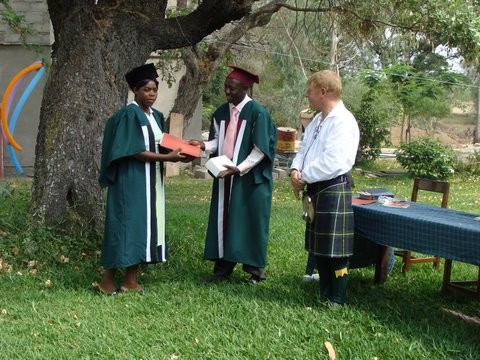
On Saturday 30th October, Mwandi Mission Centre had its graduation ceremony.
The 10 students returned to the Mission Centre for their graduation after 4 months hard work and study, a balanced combination of the practical and theoretical.


It was a warm and meaningful occasion, a special day for the students and for all present. It was a well-deserved celebration; the culmination of 4 months of hard work and devotion. It was a day to be joyful and happy for what the Lord had done amongst them and for what each individual student had achieved. We sang and danced.

We are proud of these young men and women and send them back to their congregations with our love and prayers and with those of many others world-wide.
The students were reminded that this was the beginning of something new and great in their lives after they had responded to the call to service. Engagement and involvement were paramount, because of their faith, kneeling before their communities in humility and with compassion, to support the weak and vulnerable, to seek the lost, to be company to the lonely and to welcome the stranger - all in the Lord’s transforming love.

What projects can generate income and improve the quality of life of those living in their villages? What are they, as believers, going to do about the prevalence of HIV/AIDS in their communities? What new patterns of worship, learning and teaching can they now bring to their Churches?  All these are needed responses to the challenges of witnessing in their local areas.

This incarnational work that they would be undertaking is a reflection of the work of God in Christ in the Church and in the world. God in Christ is amongst us and sharing our life, so he may redeem and change us. No part of this world is untouchable because no-one and nowhere is untouchable to God. However awful humans make parts of the world, the world is still God’s and we as God’s people need to minister with wisdom. To do this work of love and worship we need to use our minds to think, our hands to work and our hearts to pray.

Why do you need to do all this? Because God has called each one of us here to be expressions of his love and to be his Body, a Church in Mission 
These were just thoughts that jotted down in a spirit of love, joy and fellowship not a formal speech, just a pouring out of what was on my heart to friends and fellow servants of God.

After the presentation of certificates, Lemmy Milupi replied on behalf of the students, thanking all present and absent friends for their support. This was echoed in the closing speech by the Dean Pastor Percy Kawana Muleba. The students knelt and were prayed for by all the Pastors and Elders present. With a final song and dance, followed by the benediction, we retired to a celebration lunch of chicken rice and coleslaw and a time of further fellowship.

Friday, 29 October 2010

Close to home

They are a vociferous minority, in truth a bit of an awkward squad in the eyes of the central authorities. They belong to a historically separate Kingdom, and are fiercely proud of it, along with their clans, traditions and culture. They make up less than 10% of the total population in the unitary state. Their indigenous language is gradually dying out and being replaced by that of a one-time conqueror. They were forced, it is now generally agreed, into a larger union by the political elites of the time against the general will of the people. However, a Treaty was signed to safeguard certain rights and national institutions belonging to the junior partner but over the years various central governments have, either driven coaches and horses through it, or have studiously ignored it.

No, this is not another self-pitying Scottish girn, it is the Lozi people I’m talking about and the Treaty in question is the Barotse Agreement of 1964 signed by the British, Kenneth Kaunda and Litunga Sir Mwanamwina III. Barotseland, like Lesotho and Bechuanaland(Botswana), was historically a British Protectorate, from as early as 1889, obtaining protection on special terms because of their connection with mission societies and their relative isolation from other settler and colonial interests.

October 24 was Zambian Independence Day but it was apparently not celebrated in Mongu, the Lozi Administrative Capital; in fact the ceremony of raising the Zambian flag at the Blue Gums’ Stadium was boycotted. Later in the night there were running battles with the police as Lozi demonstrators stoned them after they were tear-gassed, baton-charged and live shots were fired to disperse the crowd. Reports say that five police officers were injured and two demonstrators shot and killed. There has been criticism that the police overreacted by using live ammunition and tear gas without warning or ordering the crowd to disperse before taking such drastic action. Order has now been restored and reinforcements from the Paramilitary from the line of rail have been deployed to keep it. Warrants have now also been issued for the arrest of the leaders of the two groups allegedly responsible for the disorder.

So what brought this all about? Apparently two civil groups had been asking police permission for over two weeks to hold a meeting regarding the 1964 Barotse Agreement and its omission and in fact all mention of it in the new draft of the Zambian Constitution. The police had refused to accede to their request.

Had the police allowed the meeting to go ahead in the first place, it is thought that much of the violence, bloodshed, injury and destruction to property could probably have been avoided. The meeting would have come up with resolutions to present to the relevant authorities regarding the concern over the omission of the said treaty in the draft constitution. As often is the case in such matters, the perceived insult to the Lozi people was not necessarily a deliberate snub by the Central Government but merely a lack of sensitivity and empathy, and more a matter of indifference and ignorance on its part.

And yes, believe it or not, the men do wear kilts (liziba) as well!

Thursday, 28 October 2010

Butoya retreat

After four days and five nights of melting in Mongu, we set off on Thursday for the 5-day Presbytery Retreat; this is an open air event now held every four years. The first retreat was held here in 1941. Butoya is about 15km SW of Mongu on the Barotse Plain. It takes almost an hour in a 4x4, through matapa and mishanjo (Lozi gardens cultivated at the edge of the flood plain), across fords with Monet-type water-lily pools, over mounds with palm trees, crossing rough burnt pasture and through banks of loose silver sand, We were fortunately guided well through all these obstacles by the Induna Mungambata who is the Headman in charge of the area and a Church member.
Rev Sipalo and  Rev Lubasi

The name Butoya is derived from the Mutoya tree, a type of willow. These trees form a long thicket along the river bank and the lagoons there. It is the natural beauty of the site that makes it such as special place in God’s creation for retreat and fellowship, another ‘thin place’ as George MacLeod once described Iona. It is an ideal spot for both individual or solitary prayer as well as providing under its rich thick canopy a shaded cathedral for communal gatherings to hear the Word of God preached or to praise and worship God in Church services.

The place is also of local historical interest as the first aeroplane (fulai in Silozi) landed in the area in 1928 during the reign of Litunga Yeta III. Out of the 1998 Retreat attended by over 4000 people came a much needed and prayed for revival in the United Church in Western Province.

The theme for the Conference was “Living the Salt Life as a Witness for Christ” based on Matthew 5:13 and was made up of eight topics. You, the salt, witnessing as salt, saltless salt, a salt life in our stewardship, social responsibility, salt for healing, characteristics of empowerment by the Holy Spirit, living the life of prayer and maintaining our Christian integrity. These topics were dealt with by Ministers from various Churches inside and outwith the Presbytery. The day was interspersed with early morning devotions, praise and worship, Choirs and Praise Teams as well as the topics. In the evenings after devotions were more social occasions for singing, testimonies and sketches followed by prayers at the close of the day.

Each consistory looked after its delegates another 8 joined the 8 members from Mwandi who had attended Presbytery. On Thursday we bought all our perishable goods and set out for the site. There was no ice to be had in Mongu, so this meant that another trip would need to go into Mongu on Saturday to pick up more frozen fish and meat to see us through to Monday. On arrival we were conducted to our site with a sipapela (an open shelter with walls framed by branches and covered by grass mats); this was to sleep in. We had brought our tent so it made an ideal store and larder for our provisions. A latrine had also been dug for our convenience - so to speak. We were fed well over this time spiritually and physically.

Breakfast was bread and tea or coffee. Rice pudding was also served once, Mongu rice is a well-loved staple in Zambia. Lunch and supper was buhobe (thick maize-meal porridge) or rice with fish meat or chicken and as vegetables either cabbage or kail. We did enjoy Irish potatoes as a treat on Sunday.(In Zambia potatoes are given the sobriquet Irish to differentiate them from sweet potatoes.) We are very much appreciative of the efforts of six of the ladies who undertook to cook for us all at each mealtime.

Both Ida and I learned how to bathe like a Lozi. There were no bathing facilities at the camp site, other than the river, so we joined others to bathe in the late afternoon. The rules for bathing for both sexes are apparently the same. Keith took Mubita with him to the mens area. First mistake, bathing children is womens’ work!

We were accompanied by our local MCF Convenor. After undressing myself and Mubita we slipped in the river and sat down with the soap to work up a good lather for soaping us both, Second mistake. My companion was loudly told by an old man to tell the mukuwa (white-man) to stop sitting in the sand and either to kneel or squat like everybody else! You then may soap a part of your body after that you cup your hands and pour the water you gather in them over the soaped part. When I asked why this was required behaviour, I was told it was so that you were less vulnerable in case of a crocodile attack! It was all very reminiscent of Gideon, who separated those who lapped the water with those who got down on their knees to drink!

African tribal life is quite egalitarian in many respects but it also demands a much greater degree of conformity to cultural norms than we with our more individusalistic outlook would tend to find acceptable.

During our time at Butoya we also took time to visit Sefula Mission where a kinsman of Keith’s, William Thomson Waddell worked as an artisan carpenter for Rev Francois Coillard. After building a house for Rev Jeanmairet and his new wife Elise (nee Coillard) Coillard’s niece, at Mwandi, then called Sesheke, the group of Basuto and Europeans set out for Sefula where Waddell built Coillard’s house and the Church there. We visited the graveyard where Coillard was buried. ,Waddell became engaged to Louise Keck, the teacher at Sesheke (Mwandi) before he returned home to Scotland to die of the leprosy he contracted here. We also saw the Boarding House that is named in memory of him.

The bridge and Church he built at Lwatile and Lealui await another visit on another occasion.

On our last day Mubita contracted a high temperature and diarrhoa, so we took him to Sefula Clinic where he was seen and given medicine to treat his problem. The Clinic is drawing water from the river by drum and bucket at the moment as the pump for the borehole has died and there is no money to buy the spare part.

We set off on Monday morning, after packing up at Butoya and buying provisions for the journey home and fuel in Mongu we set off via Senanga and crossed the Zambezi again on the pontoon at Kalongela. Nine hours and a puncture later we arrived back in Mwandi tired and thankful.

It was good for us all, taking time out from our busy everyday lives and devoting it to God and listening to him. It was a time of challenge, growth, exchange and blessing.

Wednesday, 27 October 2010

Western Presbytery Council Meeting

Our group consisting of Rev Lubasi, the Mwandi Interim Moderator and Mrs Lubasi, Keith, Ida, Mubita and Dorothy Katenekwa set off for Mongu at 0800h from Mwandi on Saturday 9th October and arrived 10 hours later somewhat stoorie and shoogled at Lileleyo UCZ to a warm welcome and supper.

Mongu has a chronic water shortage, as does the accommodation at the Church, so we were booked into the Sir Mwanawina III Motel, an aging complex run by Mongu District Council where running water is available for cold showering and flushing toilets most of the time. With a growing demand for electricity and other utilities, a constant supply is a problem in urban areas, so you can expect a power-cut for several hours in the evening at least twice a week. This is called ‘Load- Shedding” and we had our quota in Mongu last week.

On Sunday we attended the Opening Service for Western Presbytery. Western Presbytery is the area historically covered by the Paris Evangelical Mission Society which later became the Church of Barotseland before entering the United Church of Zambia in 1965. It is all of Barotseland, now called Western Province, with Livingstone and the Zambezi Valley from East of Sesheke added.

The first business on Monday morning was the Financial Committee, with all too familiar items of business coming up: Church Worker Stipend Scales, Remittances, Manse maintenance and renovations, Youth Hall Roofing project and the like. So many needs to be met with straitened resources. Full Presbytery Council met after lunch and dealt with matters from Synod and the JAAR project at Kalabo which is in need of some organizational development with Church oversight. There are 25 widows and retirees from Church Ministries who are cared for as well.

A new General Secretary has been appointed by the United Church of Zambia, the Rev Peggy Kabonde. Rev Kabonde is the second woman to have held the post. She was also the Church’s first woman theology graduate, and was formerly Chaplain to the University of Zambia. She was an executive member of the World Alliance of Reformed Churches and was working for her doctorate on Female Ordination, until called to fill this important and challenging position. Rev Kabonde will be inducted at All Saints, Kabwe, on 14 November

It was also agreed to form an Estate Board to oversee the management of Church Property which had been inherited from the former Mission Society. These assets and property need to be properly documented as most land was given to the Church by local Chiefs in the customary manner with no title deeds. Properties and land are not being exploited fully enough as income generating opportunities.

The following day was taken up with Consistory (Parish) Reports. With the exception of Mongu and Livingstone the other 18 Consistories in the Presbytery are rural. There are a few towns with peri-urban areas like Kaoma, Mwandi, Sesheke Senanga Limulunga and Kalabo. The rest are predominantly rural and remote and have difficulties attracting and retaining Ministers. As in Scotland, the spiritual gifts to be found amongst the congregations are being increasingly used to good effect. Many of these consistories have the services of an Evangelist who is a lay person but a Church Worker with some theological training and tasked with Church planting and the care of souls out there. They receive a small allowance from the Church but have a secular occupation, usually subsistence farming, to keep themselves and their families. Nevertheless, it was a moving and encouraging time hearing about life, work and activities being carried out by congregations as they take the gospel and witness to our Lord in their respective communities. This is often done at great personal effort, sacrifice and cost, as true Servants of the Lord.

Other matters included the employment of a Presbytery Youth Worker, enhancing computer literacy for Church staff and workers, reports from the CEVAA Council in Togo, the Girls Brigade World Conference in Malaysia and Deaconess Training in South Africa. Keith was invited to report on the opening of the UCZ Mwandi High School

The main business next day was the election of the Bishop, Presbytery Secretary and Treasurer. The incumbent Bishop Rev LM Sipalo was re-elected for a second four year term and Rev S Banda of Sefula was returned as Secretary. The Treasurer was Mr M Lubinda, a Mongu Accountant. The electoral process was conducted and scrutinized by the Bishops of Lusaka and Central Presbyteries. For each post there has to be 3 nominations and there were 46 voting delegates. Rev Sipalo will be inducted in Mongu on 19 December.

On Wednesday Council came to a close with the Bishop’s Report and a Session of the Stationing and Appointment Committee. This deals with stationing of Church Workers, their transfers and requests from them and Consistories. Some transfers are at the request of Synod, one of our Reverends was transferred to cover a Church in Kabwe following a tragic RTA in which the Kabwe Reverend and Central Province Bishop were killed. It was at this meeting that a new Minister for Mwandi was supposed to be appointed. Despite several applications there was no clear sense of calling yet from any particular individual whose cases were presented to us, so that decision will be made at a later date when all the calls have been tested. However, there were 5 other recommendations that went through ‘on the nod’.

With a final devotion, some closing remarks and a prayer the Council closed and went for supper. Incidentally, Rev Chikwanda from Kaoma, was the chaplain appointed for these sessions and he delivered a wonderful and inspiring series of devotions before each session on Servant Leadership and building up the Church

Although there was much business to get through and much of it serious, there were times of good fellowship, laughter and fun as well. Enjoying yourself and having fun at Presbytery? Whatever next!

Monday, 11 October 2010

Awaiting

Greetings from a dry dusty and roasting Mwandi as we await the rains at the end of the month, we hope. Duncan and Ina, our daughter Kirsten’s in-laws have been collecting pre-school equipment being disposed of in Edinburgh and taking it through to Kildrum to be stored until a container is organized. Our thanks go to Kildrum for putting their dunnie at our disposal. We are so pleased to have been given those wonderful toys and look forward to their being used here.

We are well but kept busy with duties at the school and hospital. The latest good news is that US$40 000 has been pledged by a US Foundation to build a classroom block at Sikuzu. This will save children a 10 mile round trip to school.

We are about to leave on Saturday for Mongu to the Western Presbytery Meeting where the new Bishop will be elected. Before the Covenanter in you chokes on your coffee, a Bishop here is in effect more of a Moderator than the priestly prelate of Presbyterian prejudice! The United Church of Zambia is actually an amazing and working mixture of Presbyterians, Congregationalists, Methodists, some Baptists and French Protestants; so there are several forms of baptism, child and adult believer, sprinkling and immersion depending on your 'tradition' and three forms of communion: the Scottish- passed around, the Methodist- on your knees at the front or the French - a series of horse-shoes around the Communion Table. Services too can be very liturgical, others are more like ours from the Common Order. Some services are more traditional and rather staid while others are quite charismatic. It is wonderful how all these manage to be accepted and welcomed by all. There is a lesson here for the Scottish Church(es).

The new Minister for Mwandi will also be elected there. Presbytery is followed by a 4- day Church Camp Retreat on an island in the Zambezi. So we have packed our camping equipment with our tents and sleeping-bags.

We will be using the inaptly named M10. Some of you, Scots of a certain age, will remember in 1970s and 80s, the A96 Aberdeen to Inverness road being referred to as the ‘goat-track’; well the M10 takes that place here in Western Province. Mongu is only 400km away but the tar runs out at Sesheke and it is sand dust and dirt to the pontoon ferry at Sitoti. After crossing the Zambezi, a dreadful drive ensues across the floodplain to Senanga., another pitted and pot-holed causeway with washed out culverts. At Senanga we enjoy tar again for the last hour to Mongu. There are only tarred roads in Western Province. We’ll leave at 0700h and get to Mongu at around 1600h

Unfinished building work
Finally, Nick has asked us if we would make urgent enquiries to try and find an individual or a small team of builders who could come now or in the near future to work on the roof of the Church of Scotland house. He is desperately needing assistance to get the roof put on before the advent of the rains and before he goes on leave at the end of November.

If any of you know of anyone who might be able to help, please let us know and get them to contact us as soon as possible. This really is a pressing need.

Friday, 17 September 2010

On home ground again

We are at present limping our way to Livingstone on a very worn front tyre due to continued suspension problems and after having the problem supposedly rectified in Lusaka. We are to pick up Jennie Chinembiri and George Lind (of the Church of Scotland's World Mission Council) from the airport while doing various items of business for school, manse and hospital.

The Reverend Silishebo has demitted office after 8 years at Mwandi and has been called to the Chaplaincy at the University of Zambia in Lusaka; the Reverend Derek Lubasi who is presently at Coillard Memorial in Livingstone will be inducted shortly as our new minister. There is a flurry of activity cleaning, painting and renovating the manse to welcome the new ‘family’ (Lubasi means family in Silozi.)

We have just spent the past week-end doing another flitting! We have moved into Hippo House – bit of a misnomer as far as size is concerned but we are fortunate to enjoy running water and electricity (most of the time) utilities denied to a large majority of the Zambian population.

Some progress has been made with the house that the Church of Scotland funded with a grant, and that Nick designed and is building. The wooden flooring is being laid at the moment. We hope we can move in before Christmas.

We are beginning to pick up the threads of where we left off. On the first Sunday evening we got back was a very moving service for the sending out of the 10 young people back to their congregations. They had been attending a 4 month Mission Course at the Church run by Percy, the Youth Pastor. They had slept in tents, cooked for themselves and freely contributed their talents and labour to various ministries to be found at the Mission. They had also has their faith challenged and deepened, intellectually and academically too they had a substantial amount of reading and writing to tackle, not just of a theological nature either but also other work needing life skills.

We have had a good and useful couple of days with Jennie and George who were able to get a taste of what we do at the Hospital and School as well as the wider Church work we undertake here. We saw them off on Saturday to Kitwe and Lusaka.

We are now back to ‘auld claes and porridge’. Ida is back to work at the AIDS Relief Programme, she has done the first scrubbing for a Caesar and has been returned her keys and asked to tackle the Central Stores which was neglected in her absence. She is a Also working with the Consistory, helping to establish a home-based care programme.

As for me I have been allocated Grade 8C for Maths and Science and 10A for History. I am at present drafting a proposal to submit to a Church Aid for teacher housing at the High School. We are still putting the finishing touches to the second classroom block and student latrines which were not finished despite efforts on my part to ensure that things should continue in my absence.

Another exciting development hoving into view is the possibility of a Community School at Sikuzu. Sikuzu is a rural community about 8km downstream from Mwandi. The children are prevented from attending school at Mwandi until they can walk the return journey each day. They are usually 8 or 9 years before this happens. So a Grade 1-4 School will be a great boon for them. At present there is a UCZ Pre-school run from the Church.

Tuesday, 24 August 2010

Getting there

On Sunday 15 Aug, Gregor, Mum and Dad accompanied us to Edinburgh Airport and bade us farewell. Our 4 months furlough has passed so quickly, yet we feel that much has been accomplished. It was a cloudless and sunny summer afternoon and it was fun sitting in the window seat on the flight to London matching the landscape below to the screen chart showing our flight path.

The onward flight to Lusaka was crowded and full with the usual universal flurry of returning families heaving and humphing, probably overweight, hand-luggage up the aisles and then carefully stowing it away in the overhead bins before everyone finally settled and relaxed.. A Carry on carry on, indeed!

We flew over a dry, red and khaki-coloured Lusaka, before landing in the early morning at the airport, Mubita was now wearing my sweater with rolled up sleeves to disguise the fact he had no trousers on. They had been removed during the night following a major spillage of apple juice!

We processed without difficulties through the Immigration and Customs formalities, luggage in tact (though now minus a pair of Mubi's shorts), and found a taxi that took us to a warm welcome back at Synod. After greeting the staff, the first thing on the 'To Do' List was to pick up our Entry Permits. After 16 years in Zambia we no longer need a Work Permit. This will save much time effort and money as these had to be renewed in Lusaka twice every five years. A visit to Immigration HQ was required, not an appealing prospect, as it is always hot, overcrowded with long queues there. However, we were fortunate as the officer dealing with our case we had got to know when he was stationed at Sesheke. He greeted us warmly with an 'Ah, my family!' So the issuing of the Entry Permits was done in under an hour.

The next problem to solve was to get our cell phones to work again. Being out of the country for 4 months meant that we needed to buy a new SIM card as our phones had been deactivated. K30 000 later to keep the same number, I was told the phone should work again after two hours. However nothing here is ever that simple and another visit to the ZAIN shop (Cell Phone Company) was required on Tuesday morning to rectify the failure of the new SIM card to operate the phone and to buy another new SIM cars for our Internet dongle. Another major inconvenience is that you lose all the numbers saved on the previous SIM card. Consumer rights and customer service are unfamiliar concepts here. You just have to learn to be grateful that ZAIN condescends to take your money!

We stay in a self-catering guest-house at the Beit CURE Hospital when we are in Lusaka so we were able to catch up with Harold and Susan Haamumba who are chaplains there. Mubita stayed with them after he was denied the visa to visit the United States. So it is like meeting up with family. Likewise we had afternoon tea with the Sitalis, other dear friends.

In the course of Tuesday afternoon we started to try and track down our 7 suitcases of unaccompanied luggage containing baby clothes, medical supplies and other donated goods that we had been given during our furlough. There was paperwork and e-mailing to be done for this. We also met Grant who was up from Mwandi to collect computer supplies that Fred Coates had sent from the States earlier on. Fred was now waiting for them at Mwandi. The day ended with shopping for supper then home to the Beit.

Wednesday morning started with a trip to the barber's for Mubita and me and the hairdresser for Ida. The car too was put into Autoworld for some much needed TLC after being parked for 4 months.Time was then devoted to visiting various retail outlets to price goods and materials for the house. The day was rounded off with a special Mwandi supper and fellowship evening graciously hosted by the Rev and Anne Sitali with the Sitali family, us and the Bangladeshi Mission Partners, Sulota from Mbereshi,and Leya Liton and Akash from Chipembi all of us first getting to know one another at Mwandi.

On Thursday the car was delivered again to Autoworld for wheel balancing and alignment and to correct the pull to the left that NISSAN is unable to fix. Both our Zambian driving licenses had expired during our furlough. Driving licenses need to be renewed here every 5 years..A medical examination and an eye-test are also required as part of the process. We had tried to have them renewed prior to our leaving but the computerisation of the process made this impossible. It was too soon! We could not drive back to Mwandi without valid licenses. So a day at the Road Traffic Department was envisaged , generally another place of officious bureaucrats ,crowds, heat and long lines. So, it was refreshing to meet Mr Mulongwe who listened sympathetically to our story, and when we explained that all the renewal paperwork was in Mwandi and ready to be processed at Livingstone on our arrival, suggested that the renewal be done in Lusaka. He was incredibly helpful in pushing this through and issuing us with temporary licenses which would last for a month, though this will mean another trip to Lusaka within the month to collect them.

We had been in touch regularly with Bridge Cargo who were clearing our suitcases and Fred Coates's computer supplies. At 1500h we were told that we could go to the Cargo Village at the Airport to collect our suitcases. Customs were releasing them early as a special delivery. The computer supplies were at the company warehouse on the Great North Road. Grant had been hoping to catch the night bus but this was increasingly a forlorn hope. We drove out to the Airport and joined the queue with the clearing agents to pay the handling fee and collect the goods. There was only one long-suffering and stoical female cashier to deal with the queue of mainly male agents and their cheeky and good-natured banter. The conversations switched easily from English to vernacular and back again. The agent from one of the major embassies was coming in for some stick as he was clearing tax free! We also met a lady we sat opposite to on the plane who was also in the queue to pick up some goods. We finally paid and picked up our suitcases. The agents from Bridge Cargo had arranged for us to pick up the computer supplies after hours. We arrived at the warehouse and squeezed the 3 boxes and the large dish into the back of our pick-up along with Grant as we had to drive with the tail gate down so the dish would fit. The two Bridge Cargo employees whom we dropped off on their way home were in the backseat along with two suitcases..

We had missed the evening Mazhandu bus to Sesheke so we left the dish in the care of the guards at Synod and arranged for Grant to be picked upby Eddie, a Synod driver, at 0600h and taken to the bus station with the over-sized dish to return to Mwandi on the first morning bus. Grant was staying next door with the Bangladeshis at the YWCA Hostel.

We then picked up Mubita who had been cared for by Mercy Sitali the whole day, allowing us to do what we had to without having to worry about him, otherwise we could not have achieved so much.

After that we bought an Indian carry-out meal and went home to watch the programme commemorating the second anniversary of the death of President Mwanawasa. So ended our 32nd Wedding Anniversary.